



“He Flies Farther, Thinks Faster”: The U.S. Navy’s Secret F/A-XX Fighter Breaks Limits With AI Power and 1,700-Mile Range (and It’s Coming Soon)
 By
Nomvula Dlamini
By
Nomvula Dlamini
| IN A NUTSHELL |
|
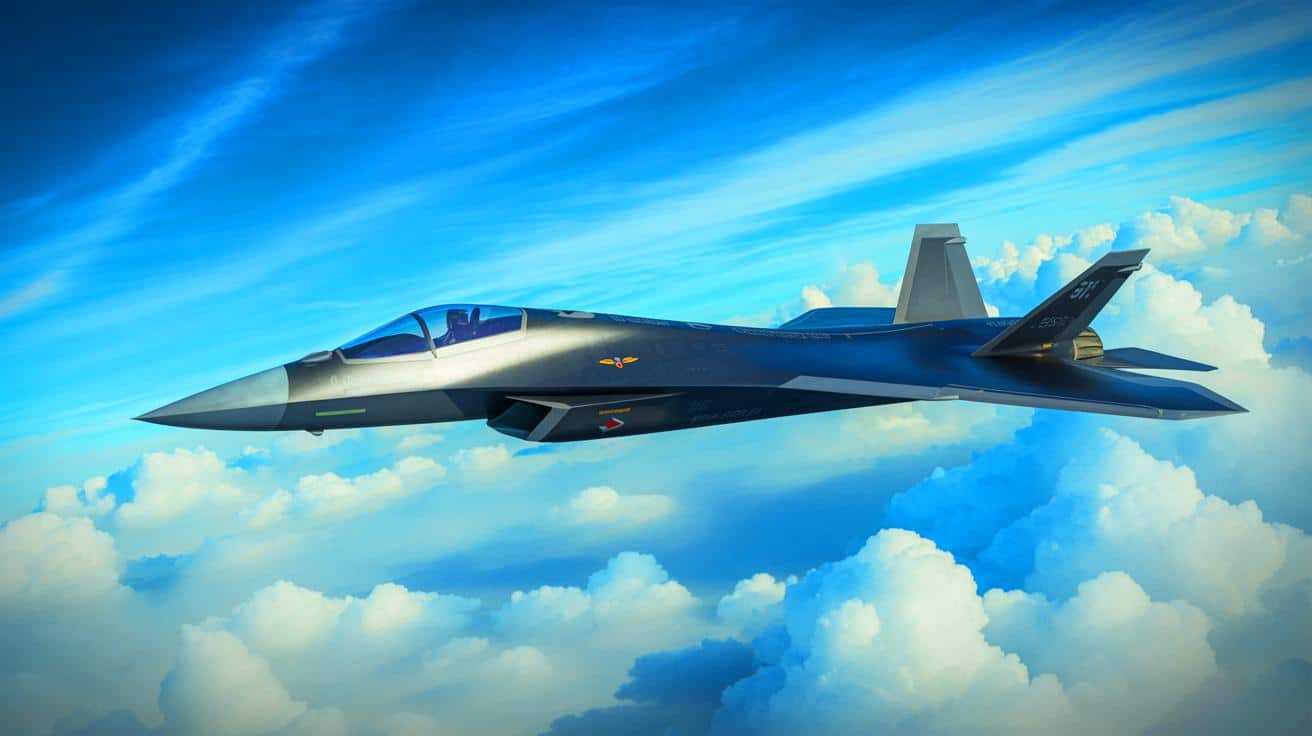
The U.S. Navy is on the brink of a groundbreaking advancement in military aviation with the development of the F/A-XX, a sixth-generation fighter jet. This aircraft promises to outstrip its predecessors, offering a 25% greater range than the existing F-35C Lightning II. The anticipation surrounding this new fighter is significant, as it is expected to substantially enhance the Navy’s operational capabilities and strategic flexibility. As more details about the F/A-XX emerge, there is a growing excitement about its potential impact on naval aviation and defense strategies, setting a new standard in aerial combat for the future.
Revolutionizing Range: 25% More Than the F-35C
At the heart of the F/A-XX’s advancements is its impressive range. Designed to extend operational reach beyond that of the F-35C by 25%, the new aircraft is expected to exceed 1,700 miles. This capability is crucial for the U.S. Navy, providing greater flexibility and power projection over vast distances without immediate refueling. In modern combat scenarios, range can be a decisive factor, allowing the Navy to maintain a strategic advantage.
Rear Admiral Michael “Buzz” Donnelly has emphasized the importance of this extended range, highlighting its role in sustaining air presence and operational effectiveness. The inclusion of refueling capabilities further enhances the fighter’s range, enabling indefinite operations with refueling support. This ensures that the Navy can maintain a robust defense posture across global areas of interest, reinforcing its ability to project power worldwide.
“Mach 7 Without Gunpowder”: China’s Electromagnetic Cannon Could Rewrite the Rules of Modern Warfare
Advancements in AI Integration and Stealth Capabilities
The F/A-XX is distinguished not only by its range but also by its state-of-the-art technological integration. Equipped with advanced AI systems, this aircraft is poised to transform air combat through enhanced battle management capabilities. The shift from a man-in-the-loop to a man-on-the-loop model signifies a significant evolution toward a fully integrated system, working seamlessly with unmanned systems like Collaborative Combat Aircraft (CCAs). This synergy between manned and unmanned operations is a game-changer for naval aviation.
Stealth capabilities are another key aspect of the F/A-XX, allowing it to penetrate advanced threat airspace effectively. By minimizing radar signatures, the aircraft can operate within hostile environments, maintaining a strategic edge over adversaries. The integration of these technologies underscores the Navy’s commitment to maintaining superiority in an evolving threat landscape, where adaptability and technological innovation are paramount.
Expanding the Area of Effect: Strategic Implications
With the addition of the F/A-XX and the MQ-25 Stingray unmanned tanker, the U.S. Navy’s carrier air wings are set to expand their area of effect to an impressive 11 million square miles. This vast operational scope is essential for maintaining a strategic advantage, enabling selective targeting and prolonged presence in critical regions. The expanded area of effect enhances survivability for strike crews by increasing the uncertainty zone for adversaries.
The ability to operate over such an expansive area is a testament to the tactical capabilities of the F/A-XX. This capability aligns with the Navy’s strategic objectives, facilitating effective navigation of complex intelligence, surveillance, and reconnaissance (ISR) environments. As global threats continue to evolve, the F/A-XX ensures the Navy’s ability to meet and overcome challenges with agility and precision.
“Power You Can’t See”: Pratt & Whitney’s F135 Engine Turns the F-35 Into a Stealth Powerhouse
The Future of Naval Aviation: A New Horizon
The F/A-XX signifies a monumental step forward in naval aviation, setting a new benchmark for future air combat operations. With its extended range, sophisticated AI integration, and stealth capabilities, the aircraft embodies the Navy’s vision for a versatile and formidable air force. The forthcoming contract award for the F/A-XX marks the beginning of a new era, where technological innovation and strategic foresight converge.
As the U.S. Navy continues to push the boundaries of what is possible, the F/A-XX stands as a symbol of progress and resilience. It represents a commitment to maintaining air superiority and safeguarding national interests in an ever-changing global landscape. How will this next-generation fighter shape the future of naval operations and redefine the dynamics of aerial warfare?
Continue reading