



“They Said It Was Impossible”: This Giant Magnet That Can Lift an Aircraft Carrier Just Brought Humanity Closer to Unlimited Clean Energy (and it’s finally real)
 By
Kwame Asante
By
Kwame Asante
| IN A NUTSHELL |
|
The international scientific community recently celebrated a remarkable achievement in the pursuit of sustainable energy. The ITER project, a collaborative international effort, has completed its sixth and final component of the reactor’s central solenoid. This powerful magnet, capable of levitating an aircraft carrier, signifies a monumental step toward revolutionizing energy production and exploring new frontiers in space travel. This achievement not only highlights a technological triumph but also underscores the importance of international collaboration in addressing global energy challenges.
Understanding the Role of the Central Solenoid
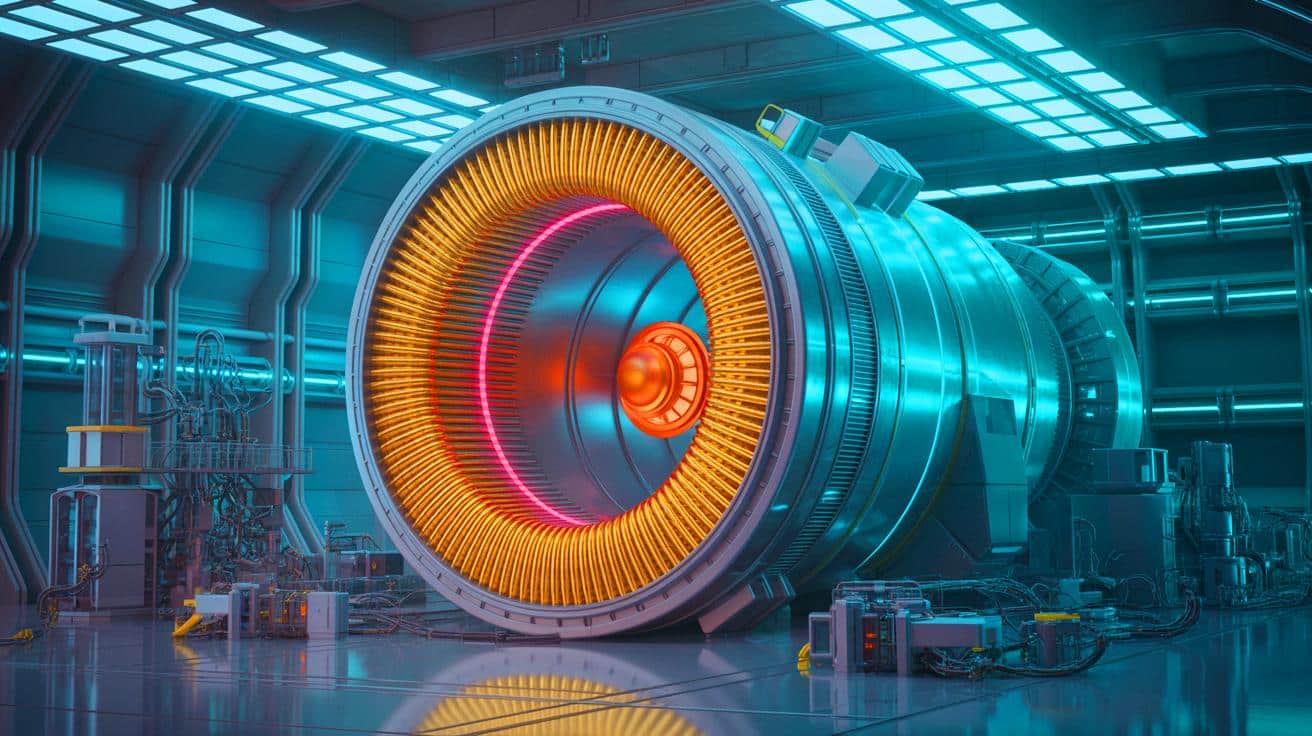
The central solenoid is a cornerstone of the ITER Tokamak reactor, functioning as the pulsating heart that powers the fusion process. This superconducting magnet is essential for creating and maintaining the superheated plasma required for nuclear fusion. The plasma core, composed of ionized hydrogen gas, achieves temperatures of 150 million degrees Celsius, which is ten times hotter than the core of the sun. This intense heat facilitates the fusion of atomic nuclei, releasing substantial energy in a process known as a fusion reaction.
When fully assembled, the solenoid will weigh nearly 3,000 tons, standing 42.6 feet tall and 13.1 feet wide. It operates in conjunction with other magnetic systems to form a magnetic cage, confining the plasma and enabling engineers to control the fusion reaction. At peak performance, the solenoid will withstand forces equivalent to 13.5 million pounds, exemplifying the engineering prowess that makes this fusion breakthrough feasible.
“These Engineers Hold the Future in Their Hands”: Westinghouse Begins Assembling the Heart of the World’s Largest and Most Powerful Fusion Reactor
https://africatimes.com/they-used-water-to-lift-the-stones-new-discovery-at-saqqara-reveals-ancient-egyptians-may-have-built-pyramids-with-hydraulic-power/539/
The Significance of a Magnet That Can Levitate an Aircraft Carrier
The significance of the central solenoid is best understood in the context of the extreme conditions necessary for nuclear fusion. The reactor’s temperatures are so high that no material container could endure them. Therefore, magnetic fields are used to suspend the plasma in mid-air, preventing direct contact with the reactor walls. The central solenoid is crucial to this process, providing the magnetic force needed to suspend the plasma for 300-500 seconds.
The magnet’s ability to levitate an aircraft carrier is not just a measure of its power but a requirement for achieving the desired fusion reaction. The solenoid’s stored magnetic energy, totaling 6.4 gigajoules, highlights its capability. This technology positions ITER to produce 500 megawatts of power with an input of only 50 megawatts, illustrating the potential for a future powered by clean, plentiful energy.
“These Pipelines Are the Lifeline of Fusion”: ITER’s Half-Mile Boron Gas Network Set to Revolutionize Plasma Purity and Unleash Limitless Clean Energy
https://africatimes.com/a-visitor-from-beyond-the-stars-interstellar-comet-3i-atlas-redefines-what-we-know-about-the-cosmos/543/
International Collaboration and Its Impact
The ITER project exemplifies the power of international cooperation. With Europe shouldering 45% of the costs and six other countries contributing 9% each, ITER is a global endeavor to meet energy demands. The project’s success underscores how nations can set aside differences to address existential challenges such as climate change and energy security.
According to Pietro Barabaschi, ITER’s Director-General, the project’s technical complexity and international framework are critical to its success. Despite fluctuating political landscapes, this collaboration has remained steadfast, proving humanity’s capacity to unite for the greater good. As the project continues, the world watches in anticipation of the transformative potential that nuclear fusion holds for our future.
“America Moves at Lightning Speed”: Federal Authorities Greenlight Fast-Track Permit for Groundbreaking 345 MW Nuclear Reactor Construction in Record Time
https://africatimes.com/this-changes-everything-we-knew-this-hidden-mineral-reveals-why-earths-deepest-plates-carry-water-miles-below-the-surface-and-its-still-happening/545/
Challenges Ahead and the Road to Completion
Despite its achievements, the ITER project faces challenges before the reactor becomes fully operational. Having started in 2007, the team now anticipates the first operation by 2035. This timeline reflects the project’s intricate nature, requiring precise engineering and coordination among international partners.
As the reactor assembly progresses, challenges such as integrating complex systems and ensuring safety standards persist. Yet, the advancements made so far inspire hope that the final goal is within reach. The successful operation of ITER could herald a new era in energy production, impacting industries and societies worldwide.
The completion of the central solenoid marks a significant milestone in the journey toward harnessing fusion energy. As the ITER project advances, it symbolizes the power of human ingenuity and cooperation. Could this fusion breakthrough pave the way for a sustainable energy future, transforming how we power our lives and explore the cosmos?
Continue reading