


Marine Life Explodes On WWII Bombs: Underwater Ecosystem Thrives In Baltic Sea’s Secret Biological Revolution
 By
Joseph Mwangi
By
Joseph Mwangi
| IN A NUTSHELL |
|
The Baltic Sea, a historical repository of military debris from World War II, has recently revealed an unexpected ecological surprise. Marine researchers conducting surveys at underwater sites discovered a diverse range of marine life thriving on submerged bombs. This ecosystem development was observed near Germany’s coastline, where long-forgotten munitions lie on the seafloor. Although these explosive remnants posed potential chemical risks, they have become unlikely sanctuaries for marine organisms, raising intriguing questions about nature’s resilience and adaptability.
Submersible Exploration Yields Unexpected Marine Life
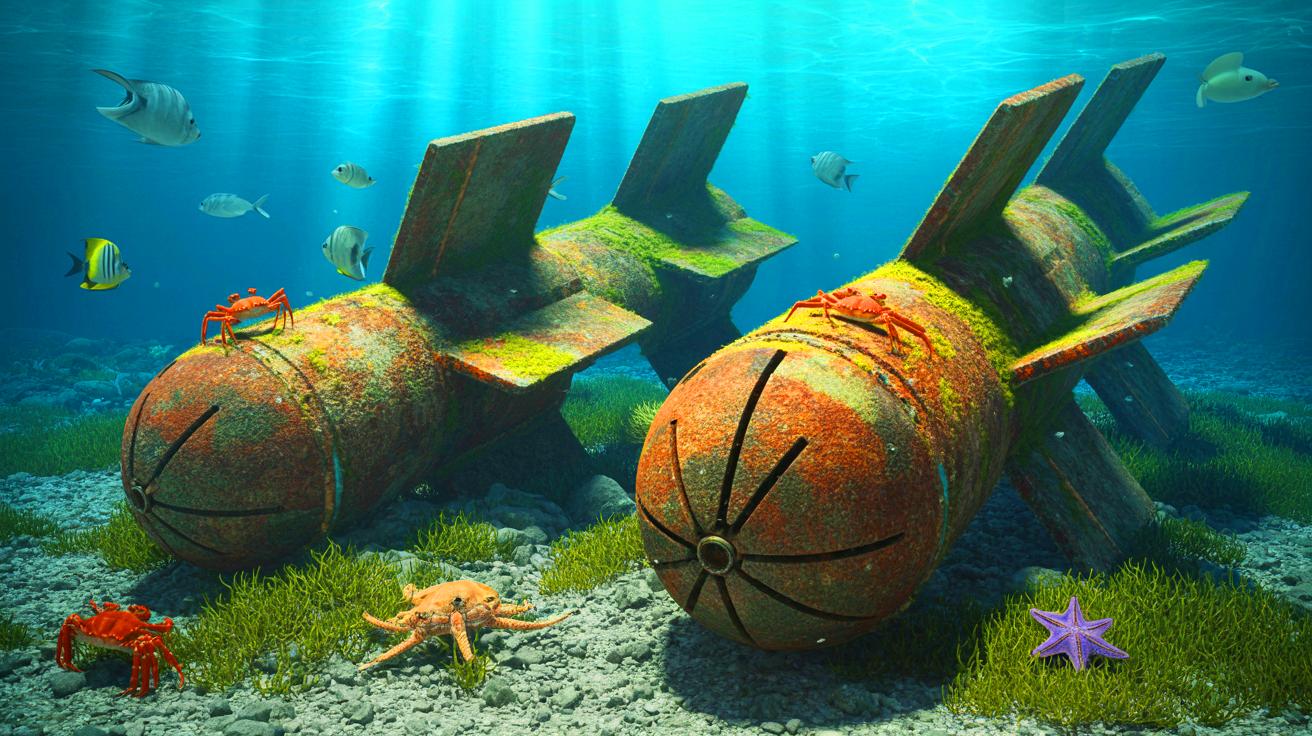
Scientists utilizing an undersea submersible in the Bay of Lübeck have uncovered a vibrant marine community on remnants of V-1 flying bombs. These bombs, deployed by Nazi Germany, now host various marine species, including crabs, starfish, anemones, worms, and fish. This discovery was made at a known weapons disposal site, where the research team initially anticipated sparse marine life due to potential toxicity. However, the opposite was found: the bomb fragments supported a dense concentration of organisms.
“We were prepared to see significantly lower numbers of all kinds of animals,” remarked Andrey Vedenin, lead author of the study from the Senckenberg Research Institute. “But it turned out the opposite.”
The findings suggest that these bomb fragments may offer favorable conditions for colonization, despite the chemical hazards typically associated with such materials. This unexpected ecological phenomenon highlights the adaptability and resourcefulness of marine life.
Bombs Serve as Artificial Reefs
The Baltic Sea’s seafloor, largely devoid of natural hard surfaces due to historical human activity, presents a unique environment. Stones and boulders were removed for construction purposes, leaving a seabed dominated by mud and sand. In this context, the solid structures of decaying bombs provide rare anchoring points for marine organisms. Despite their potential toxicity, these bombs have become artificial reefs, offering vertical structure and surface diversity that the flat seabed lacks.
Image provided by Andrey Vedenin shows sea creatures living on dumped World War II explosives in the Baltic Sea.
The transformation of these munitions into thriving ecosystems illustrates the complex relationship between human impacts and natural adaptation, raising questions about the long-term ecological implications of such artificial habitats.
Vast Quantities of Submerged Munitions
The discovery sheds light on a broader issue: the extensive presence of submerged military debris. German waters alone house approximately 1.6 million tons of dumped weapons, primarily from World War I and World War II. Among these are chemical and conventional explosives, such as TNT, which are known to leach toxic compounds into the marine environment. Despite these hazards, the flourishing marine life observed on these munitions underscores the resilience of nature.
“Normally, one does not study the ecology of bombs,” noted James Porter, an ecologist at the University of Georgia.
This revelation calls attention to the need for further research into the ecological dynamics of these underwater historical sites, as well as the potential risks they pose to marine ecosystems.
Global Warming Reveals Chilling Truth: How It Could Plunge The Entire World Into A New Ice Age
Research Opens New Ecological Questions
The study, published in the journal Communications Earth and Environment, provides high-resolution footage of ecosystems flourishing around corroded explosive casings. Researchers are now investigating how much contamination these marine organisms have absorbed and whether they are merely surviving or actively reproducing in this environment. This study parallels research by David Johnston of Duke University, who observed thriving wildlife around sunken World War I ships in the Potomac River.
“I think it’s a really cool testimony to the strength of life,” Johnston stated. “Nature has this incredible ability to reclaim and repurpose.”
The findings invite further exploration into the ways marine life adapts to and potentially thrives in environments shaped by human conflict and activity.
As the Baltic Sea continues to reveal its hidden ecological stories, the resilience of marine life challenges our understanding of environmental adaptation. This study not only highlights the enduring impact of historical conflicts on contemporary ecosystems but also prompts a more profound question: How can we balance the preservation of these inadvertent habitats with the need to address their potential environmental and safety hazards?