


“They Hit an $85 Billion Jackpot”: China’s Hidden Gold Mountain Shocks the World (and It’s Buried More Than a Mile Deep)
 By
Joseph Mwangi
By
Joseph Mwangi
| IN A NUTSHELL |
|
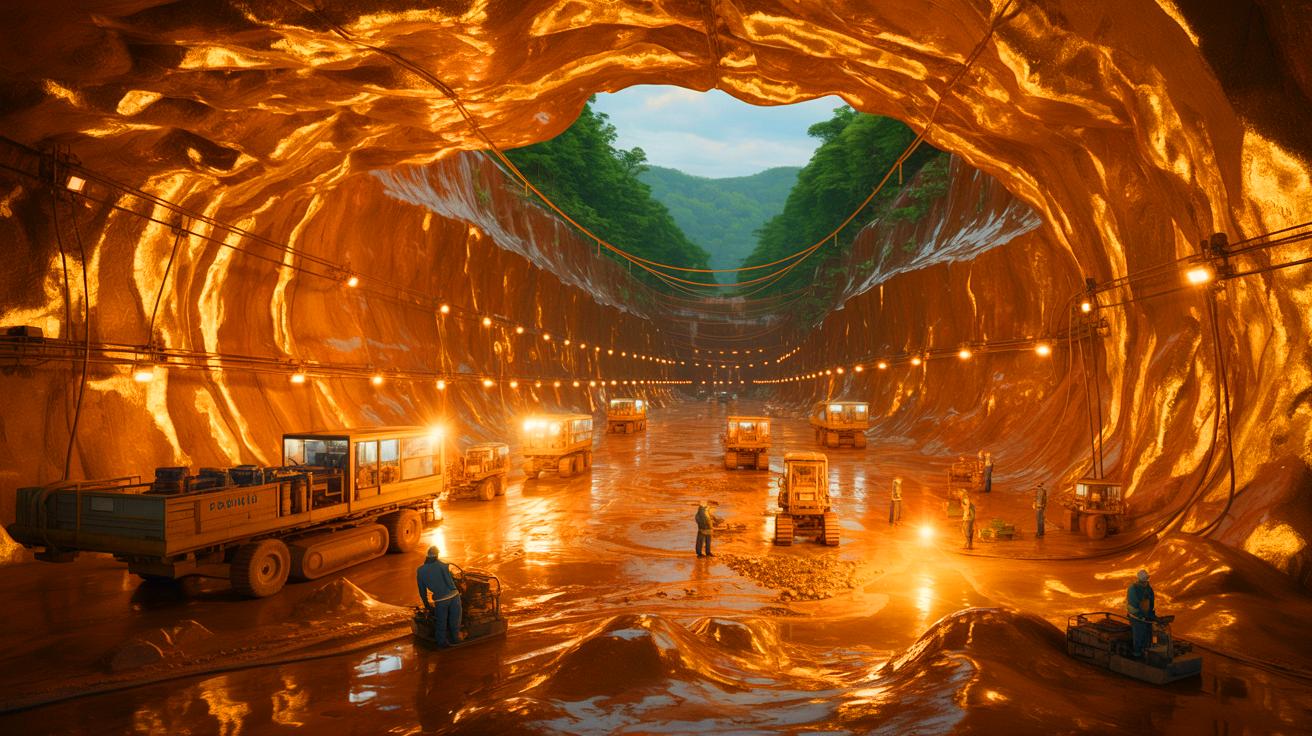
Deep beneath the rolling hills of Pingjiang County in Hunan Province, China, lies a geological wonder poised to reshape the landscape of the global gold industry. A team of geologists has discovered an immense gold reserve, valued at approximately $85 billion, making it one of the largest finds in recent history. Located over 1.2 miles underground, this deposit consists of more than 1,000 metric tons of gold. This breakthrough, enabled by advanced geological prospecting technologies, positions the Wangu gold field as a critical player in China’s resource extraction endeavors, drawing interest from both domestic and international stakeholders.
Visible Gold and a Rare Density
Within the Wangu gold field, more than 40 gold veins have been identified, penetrating the bedrock at depths of up to 1.86 miles. Initial explorations at depths of about 1.24 miles revealed reserves of around 300 tons. However, deeper drilling has uncovered even more promising layers. The ore extracted boasts a remarkable gold concentration of up to 138 grams per metric ton, a grade rarely seen in modern mining operations. Expert Chen Rulin has emphasized that the presence of visible gold within the rock cores highlights the exceptional quality of this deposit. Such visible gold is typically found only in smaller, high-grade samples, elevating the Wangu site to the ranks of the world’s most productive mines.
The high concentration and quality of the gold in the Wangu deposit have sparked comparisons with some of the most renowned mines globally. This discovery not only underscores the potential of the site but also sets a new benchmark for high-grade gold mining. As exploration continues, the potential to uncover further rich veins remains a tantalizing possibility, promising even greater economic returns.
Technology Behind the Breakthrough
The discovery of the Wangu gold field is a testament to the power of modern technology in geological exploration. Advanced surveying techniques, particularly three-dimensional geological modeling, were instrumental in this breakthrough. These technologies allowed scientists to pinpoint subterranean formations with remarkable accuracy, guiding drilling efforts toward gold-rich zones. Liu Yongjun, deputy director of the Hunan Geological Bureau, has confirmed ongoing drilling efforts around the main deposit’s periphery, leading to the identification of additional gold veins. As exploration progresses, the potential to expand the known boundaries of this vast deposit becomes increasingly likely, promising further mineral wealth.
This technological prowess not only highlights the sophistication of modern geological methods but also underscores the potential for such techniques to transform the mining industry. The ability to locate and extract resources with precision minimizes environmental impact and maximizes economic gain, setting a precedent for future mining endeavors worldwide.
A New Mining Frontier in Central China
The vast scale of the Wangu deposit positions Hunan Province as a rising force in China’s gold mining sector. The development of this field is expected to attract substantial investment, not only in mining operations but also in the region’s infrastructure. Enhancements to transport and energy networks will be essential to support this large-scale mining endeavor. Technicians from the Hunan Province Geological Disaster Survey and Monitoring Institute are currently assessing rock samples and preparing for broader extraction efforts. Although a precise timeline for commercial mining has yet to be established, the field’s potential ensures it will be a priority for future development, promising significant economic growth for the region.
This burgeoning mining frontier is poised to transform the economic landscape of central China, offering opportunities for job creation and regional development. As Hunan Province emerges as a key player in the gold mining industry, the ripple effects of this discovery are likely to be felt far beyond China’s borders.
Environmental Watchdogs Remain Alert
The vast scale of planned extraction has naturally drawn the attention of environmental watchdogs. Large-scale gold mining at such depths poses several environmental risks, including land subsidence, water contamination, and increased carbon emissions. In response, authorities in Hunan have committed to conducting operations under stringent regulatory oversight. Experts suggest that the development of the Wangu gold field could serve as a benchmark for balancing industrial ambition with environmental responsibility. While the reserve’s size is indeed headline-worthy, the methods employed in its extraction could prove equally significant, potentially setting new standards for environmentally responsible mining practices.
As the world increasingly prioritizes environmental sustainability, the approach taken by Hunan Province in developing the Wangu gold field could serve as a model for other mining operations globally. By prioritizing ecological responsibility alongside economic gain, the region has the opportunity to set a new standard for resource extraction.
The discovery of the Wangu gold field presents monumental opportunities and challenges. As the world watches this unfolding saga, the decisions made in the coming years could have far-reaching implications for both the global gold market and environmental policies. How will the balance between resource extraction and ecological responsibility be navigated in this new era of mining?