

“They Watched the Ground Tear Open”: Giant Crack in Kenya Signals Africa Is Slowly Splitting in Two (and a new ocean is forming)
 By
Kwame Asante
By
Kwame Asante
| IN A NUTSHELL |
|
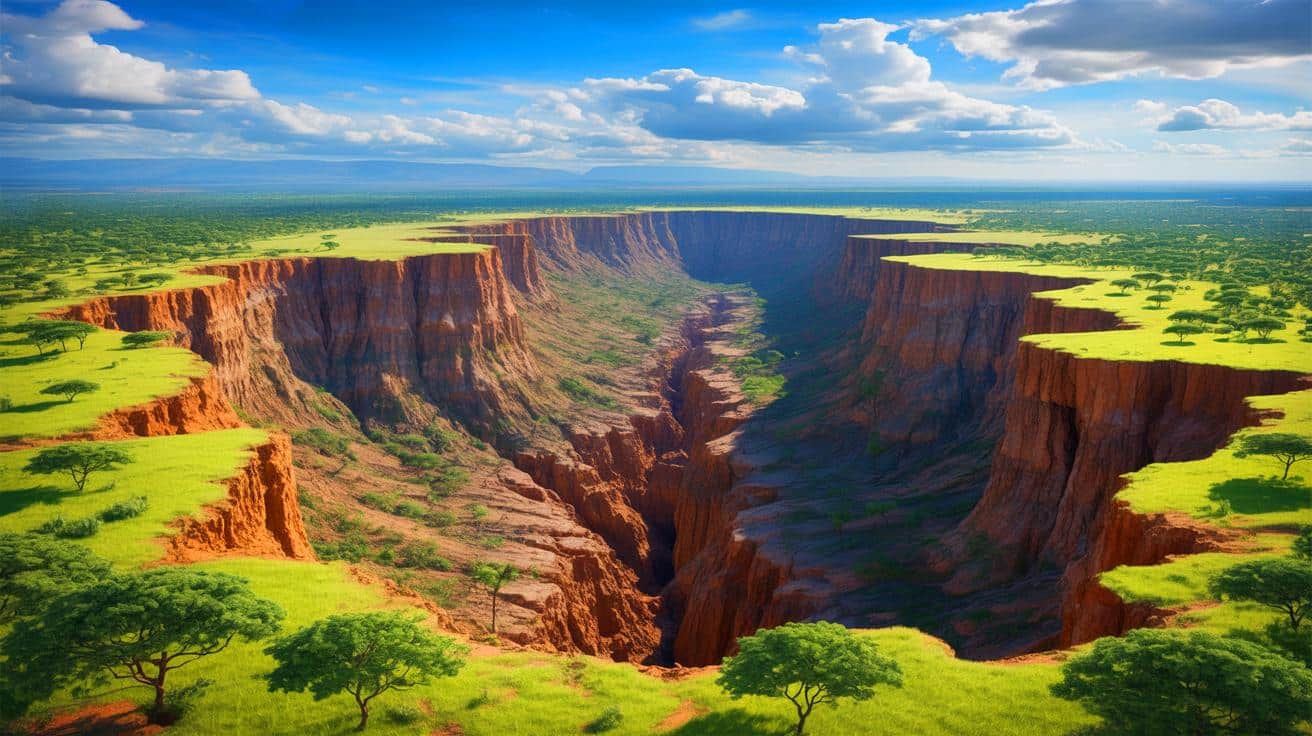
A geological marvel is unfolding in Africa, where the continent appears to be on the brink of splitting into two distinct land masses. This phenomenon, centered around the East African Rift, has intrigued scientists and citizens alike, especially with the dramatic appearance of a large crack in Kenya earlier this year. The crack, initially attributed to tectonic activity, has raised questions about the forces shaping the African continent and the potential for it to split, forming new geographic features. As these events unfold, they offer a unique glimpse into the Earth’s dynamic processes and the ongoing evolution of our planet.
The East African Rift: A Geological Wonder
The East African Rift is a significant geological feature that stretches over 1,860 miles from the Gulf of Aden in the north to Zimbabwe in the south. It marks the boundary between the Somali and Nubian tectonic plates, which are slowly drifting apart. This rift is a prime example of how tectonic forces can shape the Earth’s surface over millions of years. As these plates move, they create a series of fault lines and depressions, which can lead to seismic activity and volcanic eruptions.
In recent years, the rift’s activity has become more apparent. A large crack in southwestern Kenya caused part of a major highway to collapse, highlighting the region’s geological instability. While initially linked to tectonic movements, further analysis suggests that erosion may also play a role. However, the underlying cause remains the tectonic forces at work within the East African Rift.
Understanding the Forces Behind Rifting
Rifting occurs when the Earth's lithosphere is subjected to horizontal extensional forces, causing it to stretch and eventually rupture. This process is often accompanied by volcanic and seismic activity. In the case of the East African Rift, the driving force is believed to be a mantle plume beneath the region. This "African Superswell" is a hot, buoyant area of the mantle that causes the lithosphere to dome upward, weakening it and facilitating the rifting process.
The presence of this mantle plume not only causes the rift's distinctive topography but also contributes to the creation of new geological features. As the lithosphere stretches and breaks, it allows magma from the mantle to reach the surface, forming new volcanic rocks. This process is a precursor to the eventual formation of a new ocean basin, similar to what occurred when South America and Africa split millions of years ago.
The Slow Dance of Continental Breakup
The process of continental breakup is slow and often imperceptible. In the East African Rift, faulting and volcanic activity have been occurring for millions of years, with new fractures forming and existing ones expanding. The rift's movements are generally subtle, with seismic activity spread across a wide area and of relatively low magnitude. However, the cumulative effect of these movements is significant and can lead to dramatic geological changes over time.
As the rift continues to evolve, scientists are able to observe different stages of rifting along its length. In the south, where the rift is relatively young, volcanic and seismic activity are limited. In the north, near the Afar region, the lithosphere has thinned considerably, suggesting that a complete breakup is imminent. Once this occurs, a new ocean will form, further altering the landscape of the African continent.
A Glimpse into the Future
The East African Rift provides a unique opportunity to study the process of continental breakup in real-time. While the changes are gradual, the potential outcomes are profound. As the rift progresses, the African continent will eventually be divided, with a new ocean separating its two parts. This will result in a smaller African continent and the emergence of a large island composed of parts of Ethiopia, Somalia, and the Horn of Africa.
These changes are a testament to the Earth's dynamic nature and the powerful forces that shape it. While the prospect of a continent splitting is daunting, it also serves as a reminder of the ever-evolving nature of our planet. As scientists continue to study the East African Rift, they gain valuable insights into the mechanisms driving tectonic activity and the future of our world's landmasses.
The ongoing developments in the East African Rift challenge our understanding of geological processes and the long-term evolution of continents. As the rift continues to progress, it raises intriguing questions about the future landscape of Africa and the potential for similar events elsewhere on Earth. How will these changes impact the region's ecosystems, economies, and communities in the decades and centuries to come?
Continue reading