


“They Found Africa’s Ancient Climate Seesaw”: Shifting Rainfall Patterns That Shaped Human Evolution Are Still Influencing Us Today
 By
Joseph Mwangi
By
Joseph Mwangi
| IN A NUTSHELL |
|
Throughout history, the intricate dance of climate patterns has played a pivotal role in shaping the environment and, consequently, the evolution of species. New research sheds light on how ancient weather patterns, akin to today’s El Niño, have significantly influenced sub-Saharan Africa over the past 620,000 years. These climatic shifts, moving between wet and dry periods, are believed to have been as critical to the path of human evolution as the glacial movements observed in other parts of the world. By analyzing sedimentary records, scientists have pieced together a story of environmental change that likely steered the migration and development of early humans.
The Climate Seesaw: A Driver of Evolution
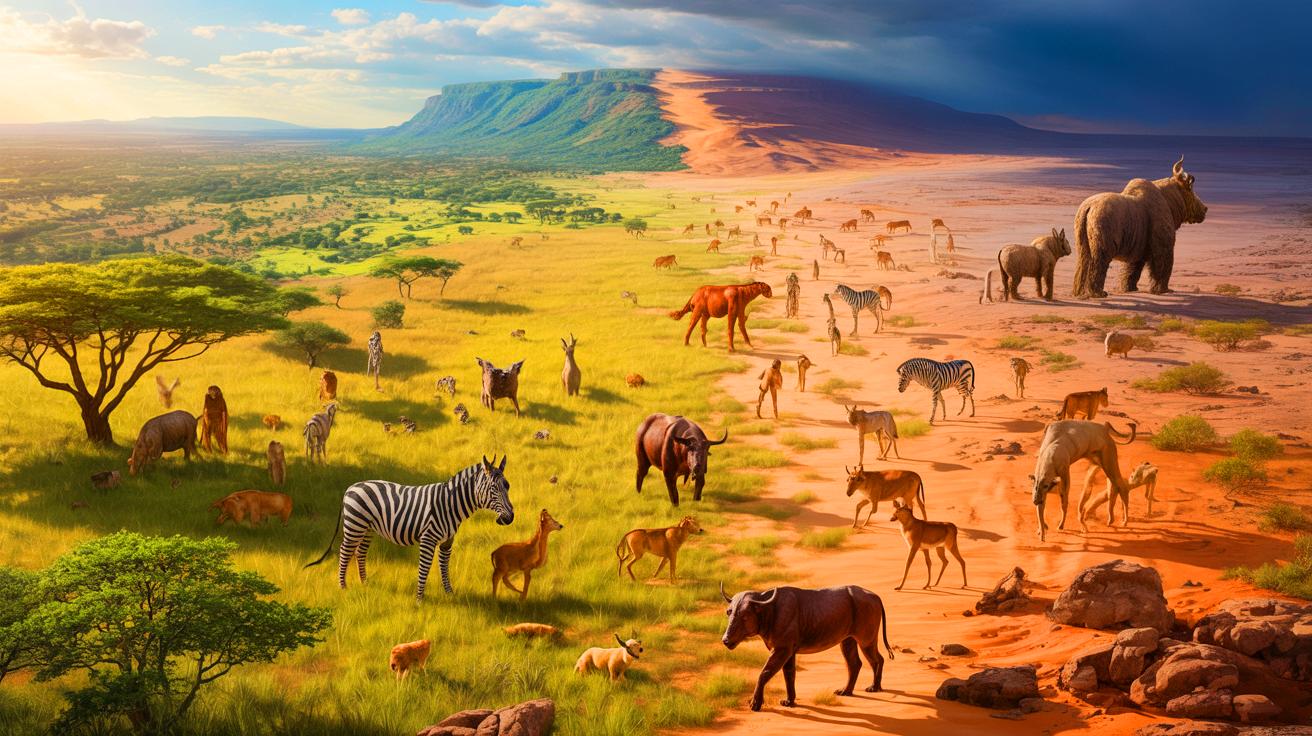
Recent research indicates that the alternating climate patterns in sub-Saharan Africa, resembling a ‘climate seesaw’, have been instrumental in the evolution of Homo sapiens. These weather oscillations between wet and dry spells have not only shaped the environment but also influenced the migration and settlement of early humans. During periods of heavy rainfall, lush environments would emerge, providing abundant resources for both flora and fauna. Conversely, dry periods would create harsh conditions, prompting migration to more hospitable areas.
Paleoclimatologist Stefanie Kaboth-Bahr from the University of Potsdam highlights the importance of these climatic shifts, stating that they governed the dispersion and evolution of vegetation and mammals in Africa. This environmental patchwork was crucial for human evolution, affecting demographic patterns and migration routes. As resources fluctuated, early humans adapted by moving to areas with favorable conditions, leading to the development of diverse cultures and innovations, though many of these were later lost or reinvented.
Impact on Human Migration and Settlement
Understanding the movement of early humans across Africa requires considering several factors, including climate. The 'seesaw' pattern of environmental change likely played a significant role in determining where populations settled. As rainfall patterns shifted, humans would have followed the availability of resources, leading to a dynamic pattern of population growth and decline. Ecotonal regions, or transitional zones between different ecological areas, became crucial for human survival and continuity.
Evolutionary archaeologist Eleanor Scerri from the Max Planck Institute for the Science of Human History suggests that these regions acted as refuges during periods of climatic stress. While local populations may have collapsed, ecotonal areas provided the stability needed for larger human populations to persist. This continuity ensured that genetic exchanges and innovations continued, despite local extinctions.
Walker Circulation and Environmental Shifts
The study of ancient climate patterns also involves understanding atmospheric phenomena such as the Walker circulation. This concept describes the movement of air around the equator and its impact on weather conditions. In Africa, changes in the Walker circulation would have led to alternating wet and dry conditions across the continent. These shifts affected where plants and animals thrived, and consequently, where humans could settle.
The research reveals that these climatic changes occurred over cycles of approximately 100,000 years, with verdant environments swinging from east to west and back again. These dynamics likely influenced the migration and behavior of early humans, as they sought out regions with stable resources. The ability to adapt to these oscillations was crucial for survival and played a significant role in shaping human evolution.
Re-Evaluating Human History Through Climate
Although tracing the exact movements of ancient humans is challenging without direct DNA evidence, the study of climate offers valuable insights. By re-evaluating patterns of stasis, change, and extinction through a climatic lens, researchers hope to gain a deeper understanding of human history. Kaboth-Bahr emphasizes that while early humans were not passive victims of climate change, shifting habitats undoubtedly impacted demographic patterns and genetic exchanges.
This research calls for a broader consideration of climate's role in human migration and evolution. By integrating climatic data with archaeological findings, scientists can build a more comprehensive picture of our species' past. This approach may reveal new insights into the resilience and adaptability of early humans, shedding light on the factors that drove our ancestors to explore and settle across diverse environments.
As we continue to uncover the complex interplay between climate and human evolution, questions remain about how these patterns might inform our understanding of future environmental changes. How might lessons from our past guide us in addressing the challenges posed by contemporary climate shifts? The answers could be crucial for our survival and adaptability in the face of ongoing environmental transformations.
Continue reading