



DNA From Ancient Mummies Reveals Shocking Lineage That Changes Everything You Thought About Human History Forever
 By
Kwame Asante
By
Kwame Asante
| IN A NUTSHELL |
|
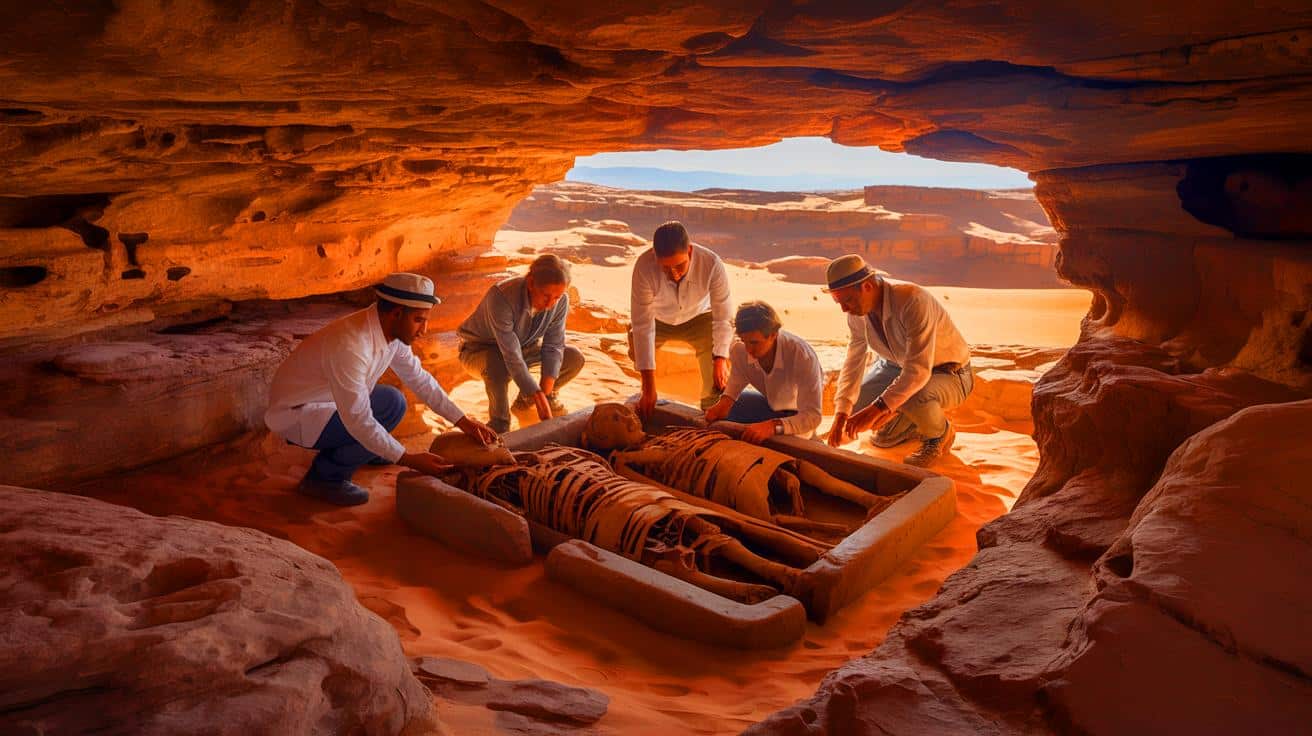
The discovery of a previously unknown human lineage in Africa has sparked significant interest in the scientific community. This groundbreaking study, conducted by an interdisciplinary team, analyzed 7,500-year-old DNA from two naturally mummified women in the Takarkori rock shelter in Libya. The findings illuminate the complexities of human evolution and migration patterns, challenging long-held beliefs about the genetic history of North Africa. As the Sahara Desert’s ancient past is unveiled, new questions arise about the early inhabitants of this region and their connections to the broader tapestry of human ancestry, offering a fresh perspective on our shared origins.
Unveiling The Ancient Sahara
During the African Humid Period, the Sahara Desert was not the vast expanse of sand we know today. Instead, it was a savanna teeming with life, dotted with trees, lakes, and rivers. This environment provided ideal conditions for early human habitation, as evidenced by archaeological findings of ancient watering holes and signs of human activity. However, as the climate shifted, the Sahara became inhospitable, creating challenges for researchers aiming to understand the human history of this region. The recent study has managed to overcome these obstacles, revealing a stable and isolated genetic population in North Africa from at least 15,000 to 7,500 years ago.
This population experienced disruption with the advent of early farming practices introduced by groups migrating from southwestern Europe. This marked the beginning of the Neolithic era in the Maghreb. DNA analysis of the Takarkori rock shelter women indicates that they belonged to a unique North African lineage that diverged from sub-Saharan populations around 50,000 years ago. Contrary to previous beliefs, North Africa maintained its distinct gene pool, separate from sub-Saharan lineages.
The Sahara’s transformation into a savanna during the African Humid Period provided optimal conditions for early human habitation.
Genetic Insights Into The Takarkori Women
The genomic analysis of the Takarkori women has provided valuable insights into the genetic history of North Africa. These women shared genetic ties with 15,000-year-old foragers from Taforalt Cave in Morocco, belonging to the Iberomaurusian lithic industry. They represent a lineage that remained genetically isolated from sub-Saharan African populations. This discovery challenges previous assumptions that there was gene flow between these regions. Instead, it highlights North Africa’s unique genetic history, characterized by a distinct gene pool.
Here’s The Discovery That Shatters Everything You Know About Humanity’s First Home Outside Africa
Interestingly, the Takarkori women exhibited less Neanderthal DNA compared to populations outside Africa, yet more than sub-Saharan Africans. This finding underscores the complex interactions between early human populations and their Neanderthal counterparts. The presence of Neanderthal DNA in North African populations suggests limited gene flow from outside Africa, further emphasizing the region’s genetic isolation.
The Takarkori women had significantly less Neanderthal DNA than people outside Africa, yet more than sub-Saharan Africans.
Reconstructing Human History In North Africa
The study’s findings have significant implications for understanding human history in North Africa. As senior author Johannes Krause noted, the research challenges previous assumptions about the region’s population history. It highlights the existence of a deeply rooted and long-isolated genetic lineage. Nada Salem, the first author, emphasized the importance of ancient DNA analysis in reconstructing human history in regions like Central Northern Africa. This research provides independent support for archaeological hypotheses and sheds light on the Sahara’s deep past.
The study suggests that pastoralism spread across the Green Sahara through cultural exchange rather than large-scale migration. This finding aligns with archaeological evidence of early human adaptation and cultural evolution in response to changing environmental conditions. By increasing our knowledge of human migrations and adaptations, the study contributes to a more comprehensive understanding of our shared human history.
“Our research challenges previous assumptions about North African population history,” said Johannes Krause, emphasizing the significance of the study.
The Broader Implications For Human Ancestry
The discovery of a previously unknown human lineage in Africa has far-reaching implications for our understanding of human ancestry. The findings challenge conventional wisdom about the genetic history of North Africa and highlight the region’s unique contribution to the broader tapestry of human evolution. This research underscores the importance of interdisciplinary collaboration in uncovering the complexities of our shared origins.
As researchers continue to explore the genetic history of North Africa, new questions emerge about the connections between early human populations and their interactions with Neanderthals. The study opens new avenues for understanding human migrations, adaptations, and cultural evolution in this key region. How might future research further illuminate the hidden chapters of our ancestral story?
Continue reading