


Here’s The Hidden Journey That Shatters Everything We Knew About Human History’s Mysterious African Exits
 By
Joseph Mwangi
By
Joseph Mwangi
| IN A NUTSHELL |
|
Thousands of years ago, long before the advent of modern technology, our ancestors embarked on epic journeys across the globe. New research suggests that these ancient travelers may have utilized routes now hidden beneath the ocean’s surface. The study highlights the possibility of submerged pathways that facilitated migrations, challenging our understanding of human history. As modern science uncovers these forgotten paths, we gain insights into the movements of early humans, offering a fresh perspective on how our predecessors adapted to their ever-changing environments.
Submerged Shores: Rediscovering Ancient Coastlines
When we envision ancient human migrations, we typically picture arduous treks across parched deserts or dense forests. However, recent findings suggest that some of these paths stretched across what are now ocean floors. During the Last Glacial Maximum, around 20,000 years ago, sea levels were up to 410 feet lower than today. This dramatic difference exposed vast land areas, transforming narrow straits into viable land bridges. These extended coastlines provided routes that early humans might have traveled, significantly altering the landscape as we know it.
Understanding these submerged pathways is crucial. They reveal not only how human populations spread but also how they interacted with their environment. The geographical transformations due to fluctuating sea levels created opportunities for migration and settlement. These routes, now hidden beneath the waves, were once bustling with life, reshaping our understanding of prehistoric human movement.
Living on the Lost Lands: Civilizations Beneath the Waves
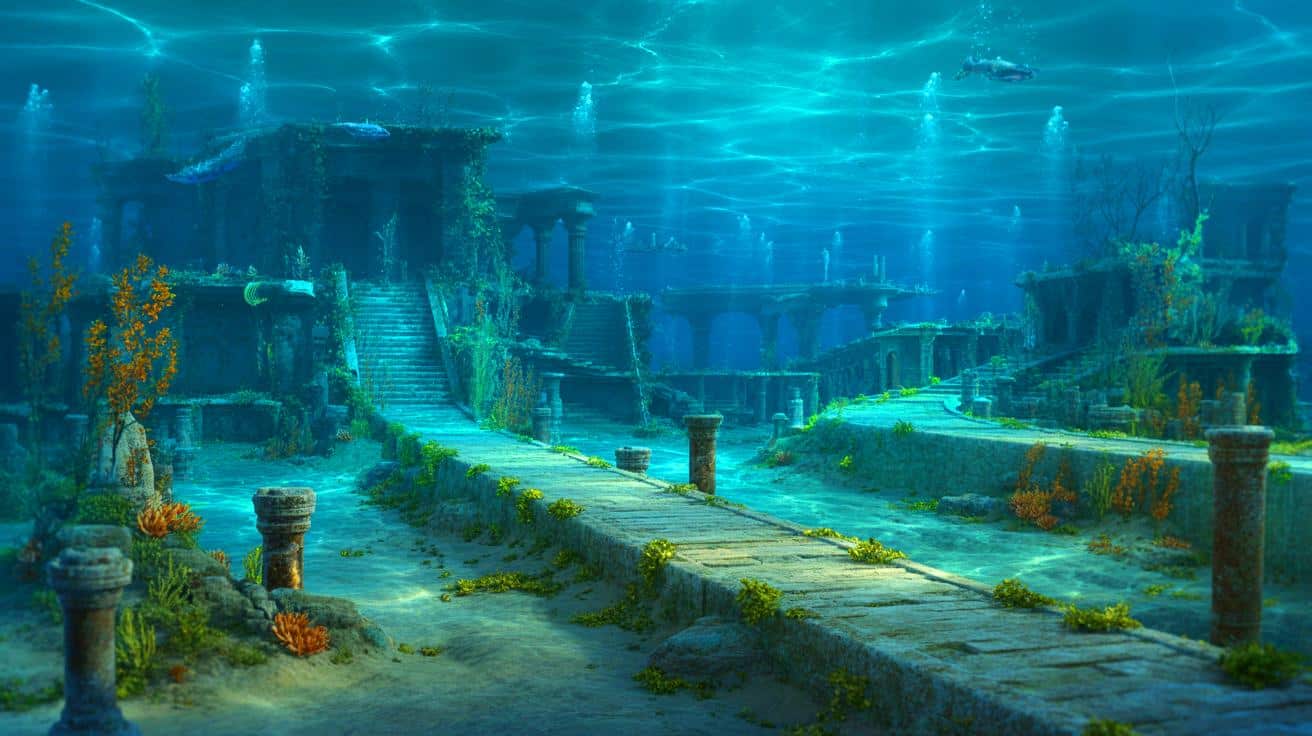
Historical references to submerged cities, such as Atlit Yam in Israel and Thonis-Heracleion off Egypt’s coast, illustrate that civilizations thrived on lands now underwater. The term “aquaterra,” coined by geographer Jerome Dobson from the University of Kansas, describes these once-emerged lands now submerged. These areas hold untapped archaeological treasures, offering a unique window into human history.
Dobson and his colleagues view these submerged landscapes as more than geological curiosities. They are potential reservoirs of archaeological information vital for understanding human history. The concept of aquaterra challenges us to rethink the locations of ancient human activity. These underwater territories may contain evidence of habitation, migration, and even the remnants of early human innovation.
Mapping the Invisible: Precision in Reconstructing Former Coastlines
To accurately map these forgotten coastlines, researchers employ a sophisticated model known as glacial isostatic adjustment (GIA). Unlike traditional methods, which simply subtract current sea levels from land elevations, GIA accounts for the Earth’s crust deformations under the weight of ice sheets. This approach allows for a more accurate reconstruction of ancient coastlines, offering clearer insights into potential migration routes.
Using this method, scientists have identified possible migration routes that might have been accessible longer than previously thought. Notable among these are the Suez Passage, the Gulf of Aqaba, the Bab el-Mandeb strait (between Eritrea and Yemen), and the straits of Sicily and Messina. These routes offer clues about the vast and intricate network of paths our ancestors might have used.
Rethinking Migrations: New Evidence and Insights
By integrating geological, genetic, and archaeological data, researchers have unveiled alternative migration routes out of Africa. Some of these routes challenge conventional beliefs, suggesting movements from south to north along the Nile Valley, or from east to west, occurring earlier or differently than previously thought. These findings propose a more complex narrative of human migration.
Evidence such as unusually large coral slabs in the Bay of Foul could be indirect indicators of human presence in submerged areas. Although these clues are still emerging, they suggest the need for systematic exploration of these underwater realms. The potential for discovering new archaeological sites holds promise for transforming our understanding of prehistoric migrations.
Toward a Comprehensive Underwater Archaeology
The ambition of researchers is clear: utilizing new maps to guide future archaeological expeditions to strategic underwater zones. These areas are likely rich with evidence on how our ancestors moved and settled. This could revolutionize our comprehension of prehistoric migrations, which until now, have been pieced together from incomplete or inaccurately dated terrestrial sites.
Jerome Dobson emphasizes the importance of this endeavor, stating,
“Many underwater landscapes have archaeological significance, and this mapping gives scientists a better chance of finding them.”
The potential for these discoveries raises new questions about the early chapters of human history. What stories do these submerged landscapes hold, and how might they reshape our understanding of where and how early humans lived?
Continue reading