


Scientists Reveal Shocking Wave That Could Prove Parallel Universe Exists And Change Everything You Know About Reality
 By
Kwame Asante
By
Kwame Asante
| IN A NUTSHELL |
|
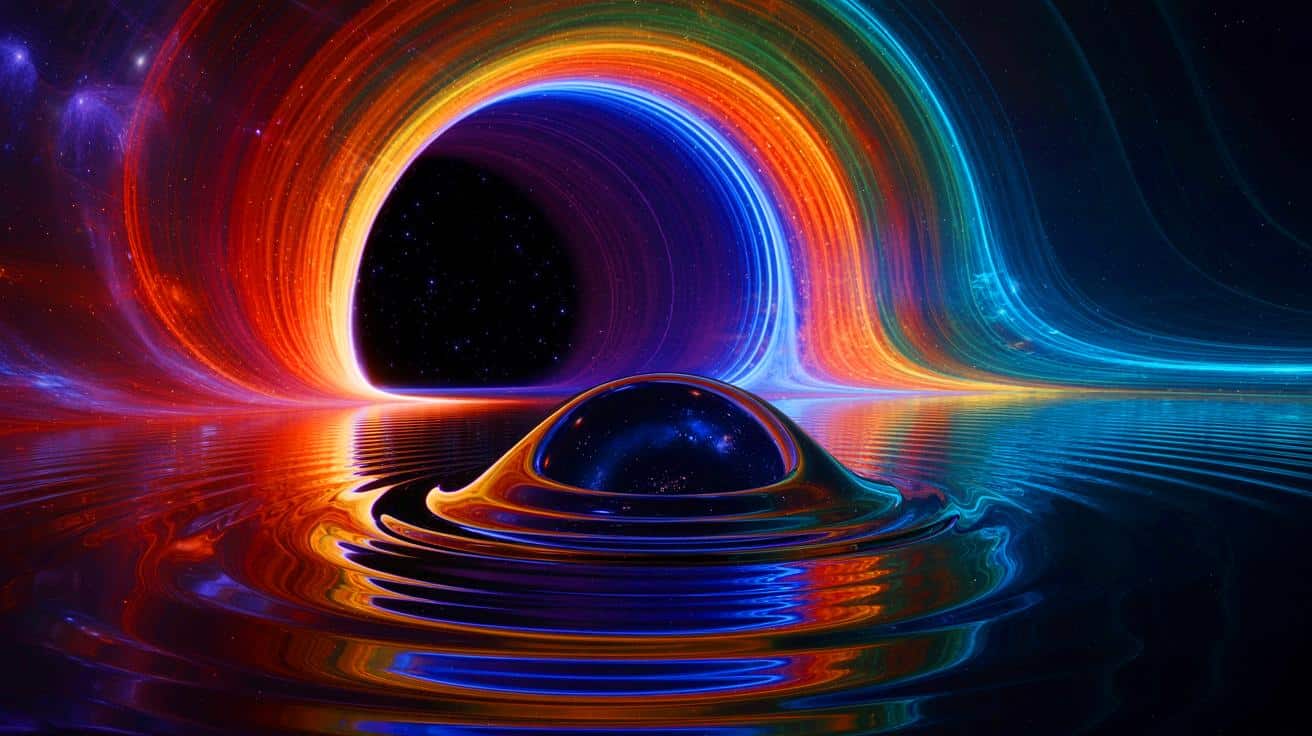
In the realm of astrophysics, recent discussions have emerged around a newly analyzed gravitational wave, GW190521, detected in 2019. This wave, initially believed to result from the merger of two black holes, has prompted scientists to consider an alternative explanation involving a wormhole connecting different universes. Researchers from the Chinese Academy of Sciences have proposed this theory, challenging established ideas and reigniting debates about the multiverse hypothesis. While the interpretation remains speculative and awaits peer review, it highlights the complexities and evolving nature of our understanding of the universe.
Rethinking Gravitational Waves: A New Perspective
Gravitational waves, described as ripples in the fabric of space-time, are typically associated with cataclysmic cosmic events. The LIGO-Virgo collaboration, responsible for identifying these waves, initially attributed GW190521 to the merger of black holes. However, the wave’s unique properties have led scientists to explore other possibilities. The brevity and structure of the signal do not entirely align with expected patterns from known black hole collisions. This discrepancy has fueled speculation about a potential wormhole connection.
The research team notes that the waveform of GW190521 lacks a clearly identifiable inspiral phase, a common feature in binary black hole coalescence. Instead, the signal appears as an isolated pulse. According to their recent paper, this could indicate an echo from a wormhole rather than a standard black hole event. The scientists suggest that the wave may have originated in a wormhole remnant – a post-merger structure connecting our universe to another through a tunnel-like “throat.”
Here’s The Discovery That Shatters Everything You Know About Humanity’s First Home Outside Africa
"A particularly compelling aspect of the GW190521 event detected by the LIGO-Virgo collaboration is that it has an extremely short duration," the researchers wrote.
Scientists Weigh Likelihood, Not Certainty
While the wormhole hypothesis is intriguing, researchers do not present it as a definitive conclusion. They acknowledge that the gravitational wave could still be a result of two black holes merging, which remains the prevailing interpretation. However, they argue that the existing evidence isn’t strong enough to fully dismiss the wormhole theory. This ambiguity places the discussion in a grey zone where conventional astrophysics meets theoretical physics.
The team's approach reflects a scientific openness to questioning established interpretations while remaining grounded in data. As stated in their paper, "the evidence is not significant enough to rule out the possibility that the echo-for-wormhole model is a viable hypothesis for the GW190521 event." This cautious stance underscores the importance of peer validation and further exploration in this field. Despite the absence of direct evidence for wormholes or other universes, the conversation continues to evolve, inviting both curiosity and skepticism.
Echoes of a Multiverse Theory
The concept of multiple universes, though often depicted in popular media, holds serious academic consideration. Theoretical physicist Alexander Vilenkin has long argued for the plausibility of a multiverse, rooted in the idea of eternal inflation. In a 2011 article in Scientific American, Vilenkin described our universe as one bubble in a vast cosmic foam, with other similar bubbles constantly forming and expanding. "We live in one of the bubbles and can observe only a small part of it," he wrote.
Although the connection between GW190521 and the multiverse theory remains speculative, the gravitational wave's unusual characteristics have brought such possibilities back into the scientific conversation. The idea that we might be part of a larger cosmic structure, with other universes existing beyond our observable boundaries, challenges conventional notions and inspires ongoing inquiry. With each new discovery, our understanding of the universe becomes more complex and intriguing.
Challenges and Opportunities for Future Research
The investigation into GW190521 presents both challenges and opportunities for the scientific community. The possibility of a wormhole or multiverse connection raises questions about the limits of current astrophysical models and the need for innovative approaches to study such phenomena. Researchers must balance open-mindedness with rigorous scrutiny as they explore these frontiers.
Future research will likely involve advanced simulations and collaborations to test the viability of the wormhole hypothesis. As scientists continue to analyze the data, they must consider the implications of their findings for our understanding of the universe. This pursuit of knowledge requires caution and creativity, ensuring that each hypothesis is thoroughly vetted and understood within the broader context of astrophysical research.
As the debate advances, a fundamental question remains: Could our universe be just one among countless others, each with its own unique properties and structures? The exploration of this possibility may redefine our understanding of reality and our place within it.
Continue reading