


NASA Reveals Ancient Sahara Formation, Older Than Dinosaurs, Offering New Insights into Earth’s Mysterious Past
 By
Nomvula Dlamini
By
Nomvula Dlamini
| IN A NUTSHELL |
|
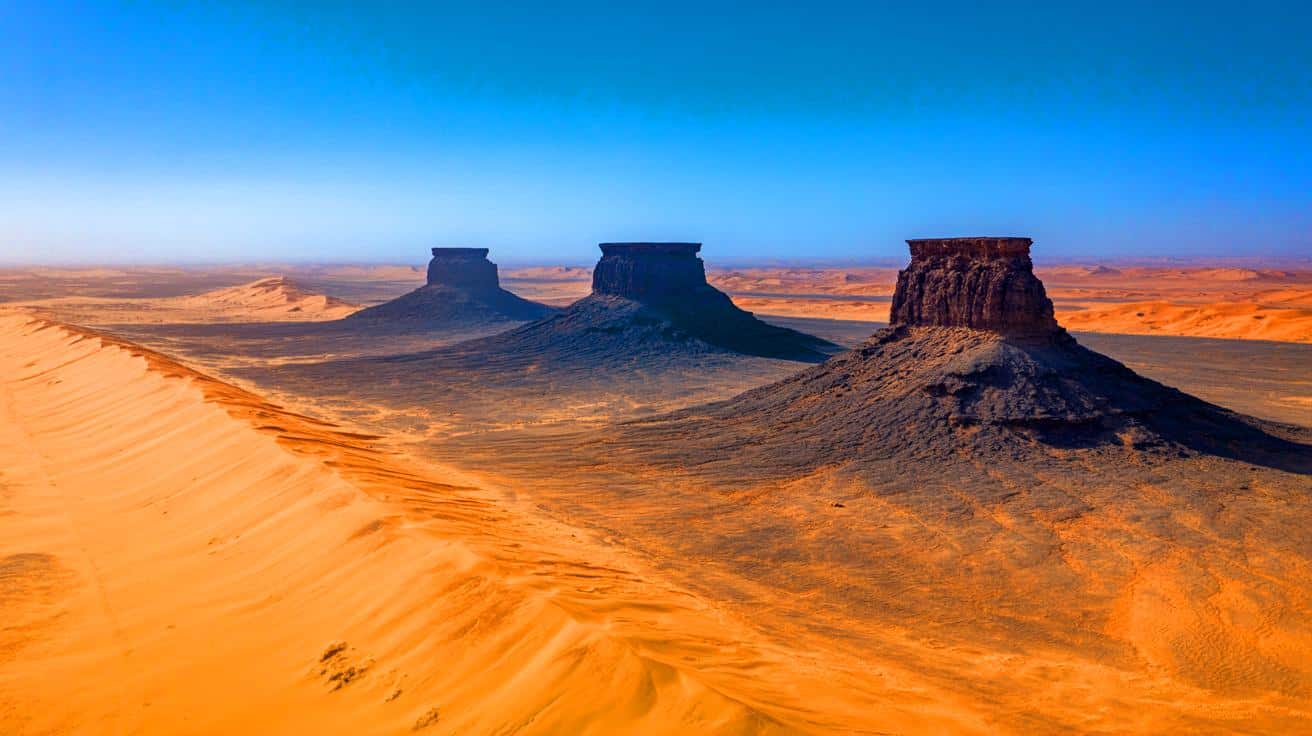
In a striking revelation from NASA’s Earth Observatory, three ancient black mesas have been identified in Mauritania, remnants of a time long before the age of dinosaurs. These geological formations, dating back to the Paleozoic Era, have sparked renewed interest among scientists. The mesas, with their distinct black tops, continue to shape the desert landscape today, creating expansive dunes and wind-swept voids observable from space. This discovery not only sheds light on ancient geological processes but also highlights the ongoing interplay between Earth’s surface and atmospheric forces.
A Snapshot From Space
In May 2023, an astronaut aboard the International Space Station captured a high-resolution image of southern Mauritania that unveiled more than just a barren desert. The photograph revealed three nearly identical, flat-topped hills, known as mesas, aligned side by side and bordered by rippling sand trails. These mesas are striking due to their dark tops, resulting from a thin layer of rock varnish. This naturally occurring glaze, composed of clay, manganese, and iron oxides, gives the mesas their shadowy appearance against the Sahara’s pale expanse.
The rock varnish, which has survived millions of years of erosion, is partly fixed by microorganisms. It stands as a testament to Earth’s enduring geological memory. The stark contrast visible in the image, with vibrant dunes to the east and barren sands to the west, is not a mere coincidence. It is the outcome of ancient geological formations interacting with modern atmospheric forces, as observed by NASA’s Earth Observatory.
The Desert’s Dual Personality
The scene captured by NASA illustrates a fascinating juxtaposition of two distinct worlds: one dominated by dunes and the other by bare rock. According to the Earth Observatory, strong winds from the east carry sand grains that accumulate along the mesas’ slopes, forming climbing dunes that appear to scale the rocky walls. These massive ridges contribute to the formation of sweeping arcs of barchan dunes, which stream out like tails behind the mesas.
Conversely, the western side presents a starkly different picture. Here, high-speed air currents pass through narrow gaps between the mesas, creating wind scour, a phenomenon that clears sand away rather than depositing it. This results in a dune-free zone – a barren corridor in an otherwise sandy landscape. The delicate balance of airflow, topography, and mineral surface explains the contrasting sand behavior on either side. This meteorological puzzle, visible from hundreds of miles above Earth, underscores the complex dynamics shaping the desert.
Echoes From the Paleozoic
Geologists propose that during the Paleozoic Era, these three mesas were part of a single, expansive rock formation. Over millions of years, continuous cycles of erosion by water and wind fractured the structure into the isolated towers observed today. These remnants are reminiscent of the Richat Structure, also known as the “Eye of the Sahara,” located approximately 285 miles north of Guérou, Mauritania.
The mesas are part of a broader category of formations found across the globe, from the deserts of the American Southwest to the surface of Mars, where similar erosional features reveal ancient climatic activity. The image captured by astronauts serves as a bridge between Earth and Mars, illustrating how both planets have been sculpted by similar relentless natural forces.
Table: Key Features of the Mauritanian Mesas
| Feature | Description |
|---|---|
| Rock Varnish | Thin layer of clay, manganese, and iron oxides giving mesas their black hue |
| Climbing Dunes | Sand dunes that appear to scale the rocky walls of the mesas |
| Wind Scour | High-velocity air currents that create a dune-free zone by sweeping sand away |
The discovery of these ancient mesas in Mauritania offers a window into Earth’s distant past, revealing the powerful forces that have shaped our planet over millions of years. As scientists continue to study these formations, they provide valuable insights into both terrestrial and extraterrestrial geology. The mesas stand as silent witnesses to a dynamic history, prompting questions about the future of Earth’s landscapes. How might our understanding of these ancient formations influence our view of current and future geological changes on our planet?
Continue reading