



Prehistoric Sea Monster Unveiled: Discover the Ancient Apex Predator Wielding Bone Blades in the Ocean’s Depths
 By
Joseph Mwangi
By
Joseph Mwangi
| IN A NUTSHELL |
|
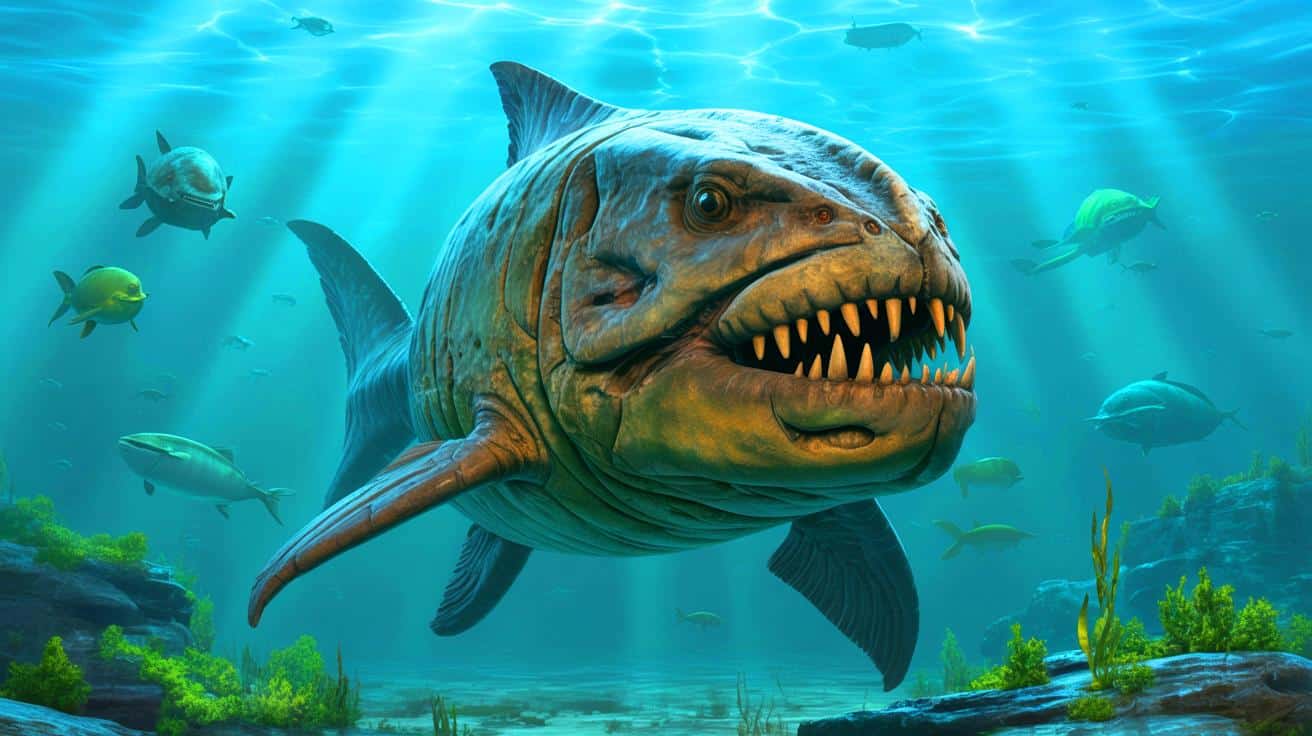
In the murky depths of prehistoric seas, a colossal predator known as Dunkleosteus once thrived. This ancient fish, measuring over 14 feet in length, roamed the waters approximately 360 million years ago. Unlike any modern creature, Dunkleosteus boasted a unique set of bone blades in place of teeth. Recent research has delved into its anatomy, revealing surprising similarities to sharks and offering new insights into its evolutionary history. This study, published in The Anatomical Record, not only illuminates the physical attributes of Dunkleosteus but also sheds light on the ancient ecosystems it dominated. As we explore these findings, we gain a deeper understanding of the complex and diverse world in which this apex predator lived.
Dunkleosteus: The Cleveland Sea Monster
When envisioning a prehistoric sea predator, one might think of creatures resembling today’s ocean giants. However, Dunkleosteus, hailing from the Late Devonian period, deviated significantly from this image. With its unusual jaw structure and bone blades instead of teeth, it was a true anomaly. This species, once the poster child for the arthrodires – a group of armored prehistoric fish – has now been revealed as far more complex than previously understood.
The discovery of Dunkleosteus’s intricate anatomy is not merely about its appearance; it offers a window into its unique evolutionary traits. Russell Engelman, the lead researcher from Case Western Reserve, emphasizes that Dunkleosteus’s anatomy had long puzzled scientists. “The last major work examining the jaw anatomy of Dunkleosteus in detail was published in 1932, when arthrodire anatomy was still poorly understood,” Engelman noted. “Most of the work at that time focused on just figuring out how the bones fit back together.”
The recent study provides a comprehensive examination of these bones, elucidating their relationship to muscle attachments and offering crucial insights into Dunkleosteus’s feeding mechanisms.
The Evolutionary Link to Sharks
One of the most captivating aspects of Dunkleosteus is its surprising connection to modern sharks. While most Late Devonian fish were encased in bony armor, Dunkleosteus was an outlier. Despite its armored exterior, its skeleton was primarily composed of cartilage, akin to that of contemporary sharks. This cartilage made up nearly half of its skull, fundamentally altering our understanding of its biology and evolutionary lineage.
Researchers have also identified a fascinating feature shared with sharks: a jaw muscle housed within its own bony channel, a characteristic absent in most other ancient fish. This structural feature is crucial for understanding Dunkleosteus’s ability to strike with precision and power. Engelman noted that “since the 1930s, there have been significant advances in our understanding of arthrodire anatomy, particularly from well-preserved fossils from Australia.” However, until now, no one had revisited the bones themselves to uncover these deeper connections.
Why Dunkleosteus Was a “Weirdo” Among Its Peers
While undeniably a formidable predator, Dunkleosteus was also notable for its distinctiveness among other arthrodires. Initially perceived as a homogenous group following similar evolutionary trajectories, recent research reveals that Dunkleosteus was anything but typical. With its bone blades instead of teeth and unique muscle configurations, it was an evolutionary oddity, not only among arthrodires but within the broader fish family tree.
This diversity among arthrodires challenges the longstanding assumption that these creatures were primitive with similar functions. The study suggests that arthrodires were highly diverse, occupying various ecological niches across different environments. Dunkleosteus, as one of the most peculiar members of this group, offers insights into the complexity and variety of ancient ecosystems.
What New Research Tells Us About Dunkleosteus’s Feeding Strategy
The feeding strategy of Dunkleosteus is as intriguing as its anatomy. Equipped with bone blades designed for slicing through prey, it likely depended on rapid and powerful jaw movements to capture its food. The recent research has illuminated how Dunkleosteus’s muscles and bones collaborated to deliver such effective strikes. Biomechanical modeling of the species provides a clearer understanding of its predatory tactics and its status as an apex predator.
Understanding the mechanics of Dunkleosteus’s jaw holds broader implications, not just for the species itself but for the entire arthrodire family. Engelman explains, “No one has really gone back and looked at what the bones themselves say about muscle attachments and function,” highlighting the significance of this study. By examining Dunkleosteus’s physical traits, scientists are unraveling the secrets of how ancient creatures adapted and thrived in their environments.
Dunkleosteus: A Glimpse Into Ancient Ecosystems
The tale of Dunkleosteus serves as a lens into ecosystems that existed hundreds of millions of years ago. During a time of significant evolutionary transitions, creatures like Dunkleosteus reigned supreme in the seas. Its massive size and specialized features enabled it to prosper in a world with few rivals. As new fossils from regions like Australia continue to emerge, our understanding of the diversity and dynamism of ancient marine life grows.
These discoveries, documented in The Anatomical Record, not only enhance our comprehension of Dunkleosteus but also remind us of how much remains to be uncovered about prehistoric life. Ancient creatures like Dunkleosteus were not just passive inhabitants of their environments – they actively shaped their ecosystems in ways we are only beginning to grasp.
The narrative of Dunkleosteus extends beyond its fearsome appearance, offering insights into the ancient marine ecosystems it once dominated. As scientists continue to uncover more about its anatomy and evolutionary connections, new questions arise about the role of such apex predators in shaping their environments. What other secrets might these ancient creatures hold that could further illuminate the complexities of our planet’s distant past?
Continue reading