



Scavenging Reshapes Human Evolution, Study Reveals Its Greater Role Over Hunting in Our Ancestral Development
 By
Kwame Asante
By
Kwame Asante
| IN A NUTSHELL |
|
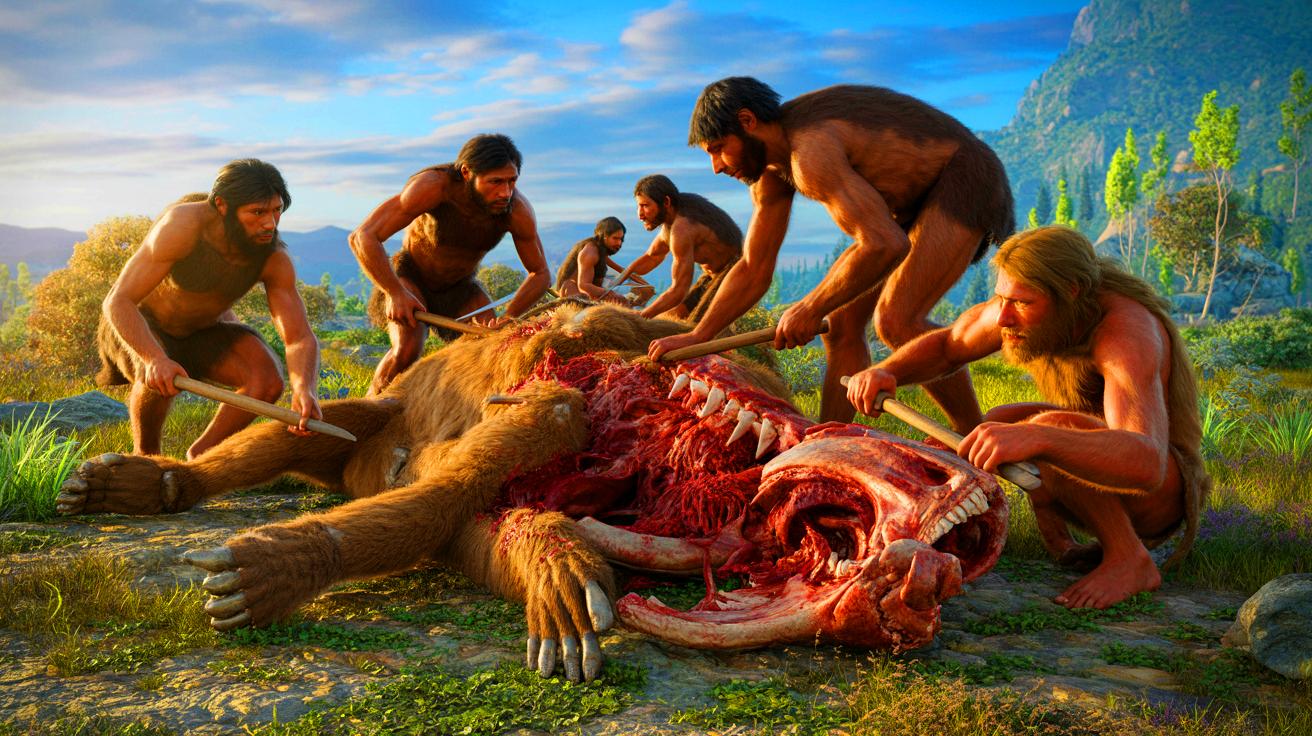
In a groundbreaking study, researchers have reevaluated the long-held beliefs about early human survival strategies, suggesting that scavenging, rather than hunting, played a pivotal role in human evolution. This new perspective, detailed in the Journal of Human Evolution, challenges the traditional view of our ancestors as primarily hunters and instead highlights scavenging as a critical survival tactic. By examining evidence from paleoanthropology and ecology, the study sheds light on how scavenging may have shaped the development of early hominins and contributed to the evolutionary path that led to modern humans. As we delve into this research, we explore the implications of scavenging on both ancient and contemporary human societies.
Scavenging: A Strategy Built on Opportunity, Not Desperation
For decades, scavenging has been viewed as a secondary survival tactic, often perceived as a desperate measure when hunting efforts failed. This perception painted scavenging as a primitive and risky strategy. However, new research conducted by Ana Mateos and Jesús Rodríguez at the Centro Nacional de Investigación sobre la Evolución Humana (CENIEH) challenges this notion. The study suggests that scavenging was not only feasible but also an efficient way for early humans to secure food resources.
By examining the availability of carrion, or animal remains, the researchers found that scavenging provided a reliable and nutrient-rich food source, especially during periods of food scarcity. Carrion availability often coincided with environmental conditions that made hunting difficult, such as dry seasons or climatic shifts. In these times, scavenging may have been a strategic choice rather than a last resort. Mateos notes, “When large terrestrial and marine mammals die, they provide tons of easily accessible food, enabling many scavenger species to coexist and feed at the same time.”
This perspective shifts the narrative from scavenging as a chaotic and unpredictable behavior to one that was aligned with survival strategies. Instead of being a fallback option, scavenging may have been a deliberate and intelligent response to ecological constraints faced by early humans.
The Biological Blueprint of a Scavenger
The study’s authors argue that humans possess several traits that naturally predispose them to scavenging. These traits extend beyond the use of tools and include aspects of human anatomy, physiology, and movement. One significant advantage is human endurance. Unlike many carnivores, early humans could travel long distances in search of food with minimal energy expenditure. This endurance made it possible to locate carrion effectively.
Mateos highlights, “Humans can travel long distances with relatively little energy expenditure compared to other mammals, which is essential for locating enough carrion.” This ability to cover vast distances was a key factor in the success of scavenging as a survival strategy.
Scavenging also drove innovation among early hominins. Simple stone tools allowed our ancestors to access the nutrient-rich tissues of large animals. Even basic flake tools could cut through thick hides, reach the interior, and scrape off remaining meat. Stones used as hammers enabled early humans to break bones and access the valuable fat and marrow inside.
This evolutionary path from scavenger to skilled processor may have laid the groundwork for technological advancements, including the eventual use of fire. These innovations, driven by the need to efficiently utilize carrion, played a significant role in shaping the development of early humans.
Carrion as a Driving Force in Ecosystems and Cultures
The study extends its findings beyond prehistoric evidence, connecting ancient scavenging behaviors to modern foraging practices. Many contemporary hunter-gatherer societies continue to incorporate scavenging into their survival strategies, emphasizing that eating carrion is not a sign of desperation but a flexible and effective behavior.
“Today we know that carrion plays a fundamental role in ecosystems and that all carnivorous species consume it to a greater or lesser extent,” the researchers note. This perspective reflects a broader trend in ecology, recognizing the ecological value of scavengers in maintaining ecosystem balance. Humans, too, have never been fully separate from the cycles of death and decay that sustain life on Earth.
Published in the Journal of Human Evolution, the research reframes scavenging through the lens of optimal foraging theory, portraying it as an adaptive behavior rather than a fallback. In this view, scavenging was not a sign of weakness but an intelligent response to the ecological constraints faced by early humans.
The Role of Scavenging in Human Evolution
Scavenging’s impact on human evolution extends beyond survival strategies. The practice may have influenced the development of social structures and cultural practices among early hominins. Scavenging often required cooperation and communication among individuals, fostering social bonds and the exchange of knowledge. These interactions may have laid the foundation for the complex social dynamics that characterize modern human societies.
Furthermore, the nutritional benefits of scavenging could have played a role in the development of larger brains in early humans. Access to protein-rich tissues and fatty marrow provided essential nutrients that supported brain growth and cognitive development. This nutritional advantage may have given scavenging hominins an edge over their hunter-only counterparts.
As we consider the implications of scavenging in human evolution, it becomes clear that the practice was not just a survival strategy but a driving force behind key innovations. From tool use to social organization, scavenging contributed to the evolutionary trajectory that led to the emergence of Homo sapiens.
The research on scavenging challenges our understanding of early human survival and highlights the importance of reevaluating long-held beliefs. By acknowledging the role of scavenging in our evolutionary history, we gain a deeper appreciation for the adaptability and resilience of our ancestors. How might this new perspective on scavenging influence our understanding of human evolution and the factors that shaped our species?
Continue reading