



Ancient Native American Star Chart Reveals Enigmatic Secret, Leaving Experts Puzzled and Sparking Fascination Worldwide
 By
Kwame Asante
By
Kwame Asante
| IN A NUTSHELL |
|
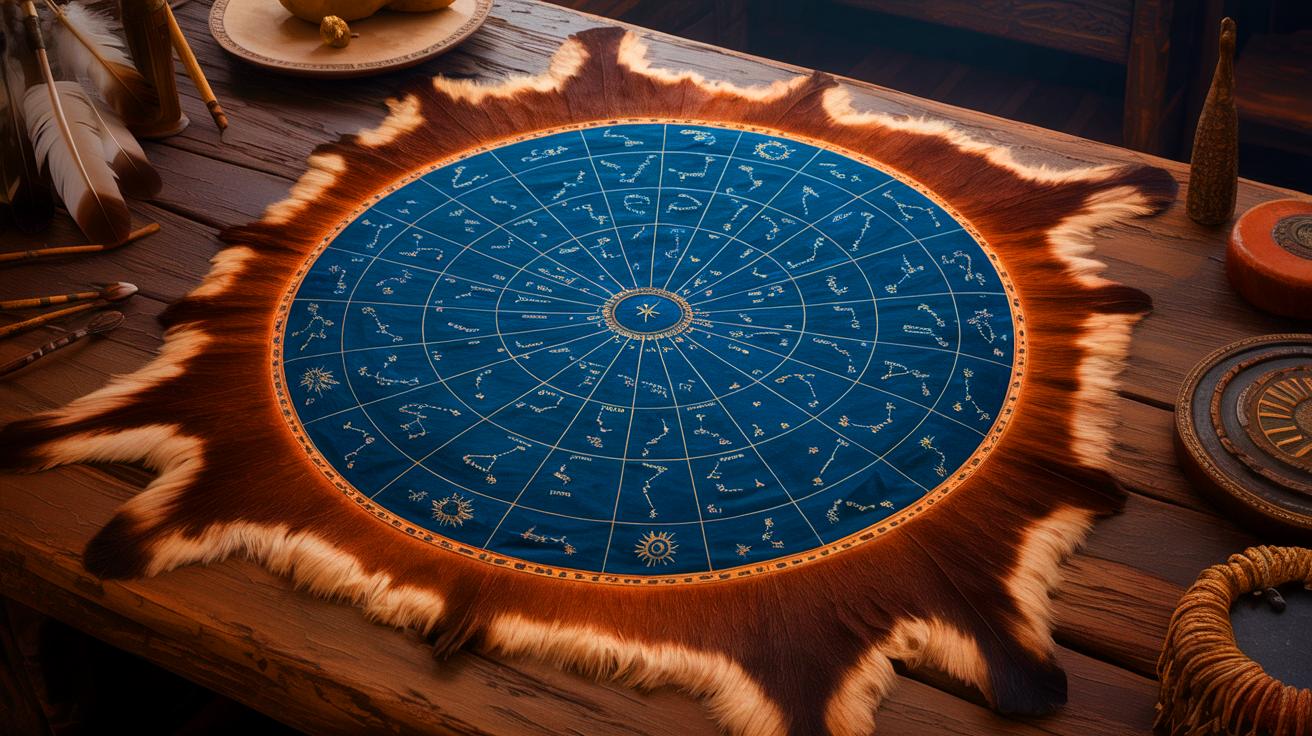
The Skiri Pawnee’s ancient star chart remains an enigma, straddling the line between celestial mapping and cultural storytelling. This elk-skin artifact, believed to date back to the early 17th century, continues to captivate researchers and historians. While initially thought to be a simple tool for stargazing, deeper examinations have revealed a complex tapestry of cultural significance and cosmic storytelling. As scholars delve into its mysteries, the chart challenges our understanding of maps, not just as navigational tools but as repositories of memory and meaning. This exploration not only sheds light on the chart itself but also on the broader cultural practices of the Skiri Pawnee.
The Star Chart: A Map or a Sacred Teaching Tool?
The Skiri Pawnee star chart, a compact artifact measuring 15 by 22 inches, initially appears to align with the Western tradition of celestial mapping. Dotted with points seemingly representing stars, it was first interpreted as a practical guide for observing the northern sky. However, ongoing research suggests a different narrative. Far from being a mere stargazing guide, the chart may have served a more profound purpose.
Recent studies propose that the elk-hide chart was a conceptual diagram designed for ceremonial use, rather than a functional map. This perspective situates the chart at the crossroads of science and spirituality, where cosmological stories and rituals hold as much weight as astronomical observations. Understanding this chart requires an appreciation of Skiri Pawnee culture, where sky knowledge is integrated into a broader ceremonial framework. This shift invites new questions about how memory and tradition shape our understanding of maps and how knowledge is passed through generations.
The Significance of the Elk-Skin Chart in Skiri Culture
In Skiri Pawnee culture, the star chart likely served as more than a representation of the stars. It was a mnemonic device, a bridge between cosmic teachings and daily life. Indigenous cultures often imbue objects like this chart with active roles in knowledge transmission. Preserved on elk skin, the chart might have been part of a sacred bundle – a collection of objects with ritual significance, used in ceremonies to teach the community about its cosmic and earthly connections.
Unlike Western maps that aim for precision, the Skiri chart might encode meanings and teachings linked to the stars. It functioned as a sacred object, imparting wisdom about the cosmos, seasons, and time’s passage. The rituals surrounding this chart were central to maintaining life’s balance within the Skiri community. Thus, the chart was not a simple guide to the sky but a crucial element of cultural and spiritual continuity.
Memory, Storytelling, and the Pawnee Star Chart
The chart underscores the importance of memory in Indigenous knowledge systems. In Skiri tradition, sacred bundles were central to ceremonies, teaching, and guiding the community. These teachings were dynamic, meant to be lived and shared, with the star chart acting as a living document. It encoded more than star positions; it held the practices and stories that gave those stars meaning.
Researchers like Douglas R. Parks, who have extensively studied Pawnee culture, suggest the chart’s primary function was not to map the sky in a Western sense. Instead, it offered a holistic understanding of the stars’ significance, teaching vital seasonal knowledge tied to Skiri rites. This understanding was embedded in the community’s life rhythms, guiding when to plant crops or hold ceremonies, making the chart a critical cultural artifact.
Blending Science and Story: How the Chart Challenges Modern Understanding
The debate over whether the Pawnee star chart is a map or a sacred story highlights a broader issue: Can Indigenous knowledge be fully understood through Western frameworks? This question underscores the potential pitfalls of applying rigid scientific classifications to Indigenous artifacts, which may serve different purposes and hold different meanings.
Earth.com notes the growing recognition that Indigenous diagrams often function as teaching tools, conveying meaning in non-obvious ways to outsiders. The chart reminds us that knowledge transmission goes beyond data points on a map; it is woven into stories, rituals, and lived experiences. Ethnoastronomy, which studies how cultures interpret the sky, offers valuable insights into how the Skiri Pawnee view the universe. By examining the chart in this context, researchers can appreciate that the stars’ meaning is culturally shaped, making the chart an object of both scientific and cultural significance.
Rethinking Maps and Knowledge in Indigenous Cultures
The Pawnee star chart challenges conventional views of maps in Western culture. Typically viewed as objective navigation tools, maps in Indigenous cultures often convey deeper understanding. For the Skiri Pawnee, the chart was less about physical geography and more about the stars’ intersection with community life and responsibilities. It was a map of knowledge, guiding people through seasons, rites, and stories.
Experts in mapping note that many Indigenous cultures use diagrams not as literal maps but as symbols that encode vast knowledge. Prayer sticks, petroglyphs, and star charts often act as symbolic knowledge repositories, deeply meaningful to those within the culture. As such, the Pawnee star chart serves as a testament to the richness and depth of Indigenous knowledge systems, urging us to reconsider how we perceive and interpret maps and cultural artifacts.
The Skiri Pawnee star chart remains an intriguing artifact, offering a window into a world where science and story converge. It challenges modern perceptions of maps and invites us to consider how knowledge is shared across generations. As researchers continue to explore its mysteries, the chart prompts broader questions about cultural preservation and the ways we understand and value different knowledge systems. How might this ongoing exploration reshape our understanding of both the stars and the cultures that interpret them?