


Dinosaur Mummies Reveal Stunning Details, Offering New Insights Into Prehistoric Life and Changing Our Understanding
 By
Kwame Asante
By
Kwame Asante
| IN A NUTSHELL |
|
In a remarkable leap forward for paleontology, a team of researchers has unveiled unprecedented details about the appearance of the duck-billed dinosaur, Edmontosaurus annectens. By studying exceptionally preserved fossilized “mummies” found in Wyoming, scientists have reconstructed this dinosaur’s skin, hooves, and other soft features with remarkable clarity. These discoveries mark a significant advancement in our understanding of prehistoric life, providing answers to long-standing questions about dinosaur biology. This research, spearheaded by the University of Chicago, highlights the potential of modern imaging and excavation techniques in shedding light on the mysteries of ancient creatures.
The Significance of Dinosaur Mummies: Not Just Fossils
To many, dinosaurs are little more than skeletons or fossilized bones displayed in museums. However, the discovery of fossilized mummies of the Edmontosaurus offers a rare glimpse into the softer side of these ancient giants. Unlike traditional fossils, these mummies retain impressions of soft tissues, thanks to a unique preservation process known as clay templating. This process occurs when a dinosaur’s carcass is buried rapidly, allowing a thin layer of clay to form a protective shell over the skin and soft tissues. This preservation method is extremely rare, making these finds invaluable for scientists.
Dr. Paul Sereno, a senior author of the study, emphasizes the significance of this discovery:
“It’s the first time we’ve had a complete, fleshed-out view of a large dinosaur that we can really feel confident about.”
Located in Wyoming’s “mummy zone,” these finds have contributed substantially to piecing together the puzzle of dinosaur life, offering insights that simple bones could never provide.
The Mystery of Clay Templating: How Soft Tissue Survived
The clay templating process is a fascinating phenomenon that captures the intricate details of dinosaur skin and features. After the Edmontosaurus died, its body was buried under layers of sediment, with clay forming a delicate template over the dinosaur’s surface. This template preserved the texture and structure of the skin long after the organic material decomposed. Sereno describes the process as creating a mask so thin it could be blown away, yet it holds the key to understanding the dinosaur’s appearance.
This rare type of preservation allows researchers to use advanced imaging techniques, such as X-ray scans and 3D modeling, to recreate how these dinosaurs might have looked. The study of these mummies, published in the journal Science, offers a detailed look at the Edmontosaurus, from its scaly skin to the contours of its flesh, providing a visual representation that was previously unattainable.
An Unprecedented Look at the Skin and Features of Edmontosaurus
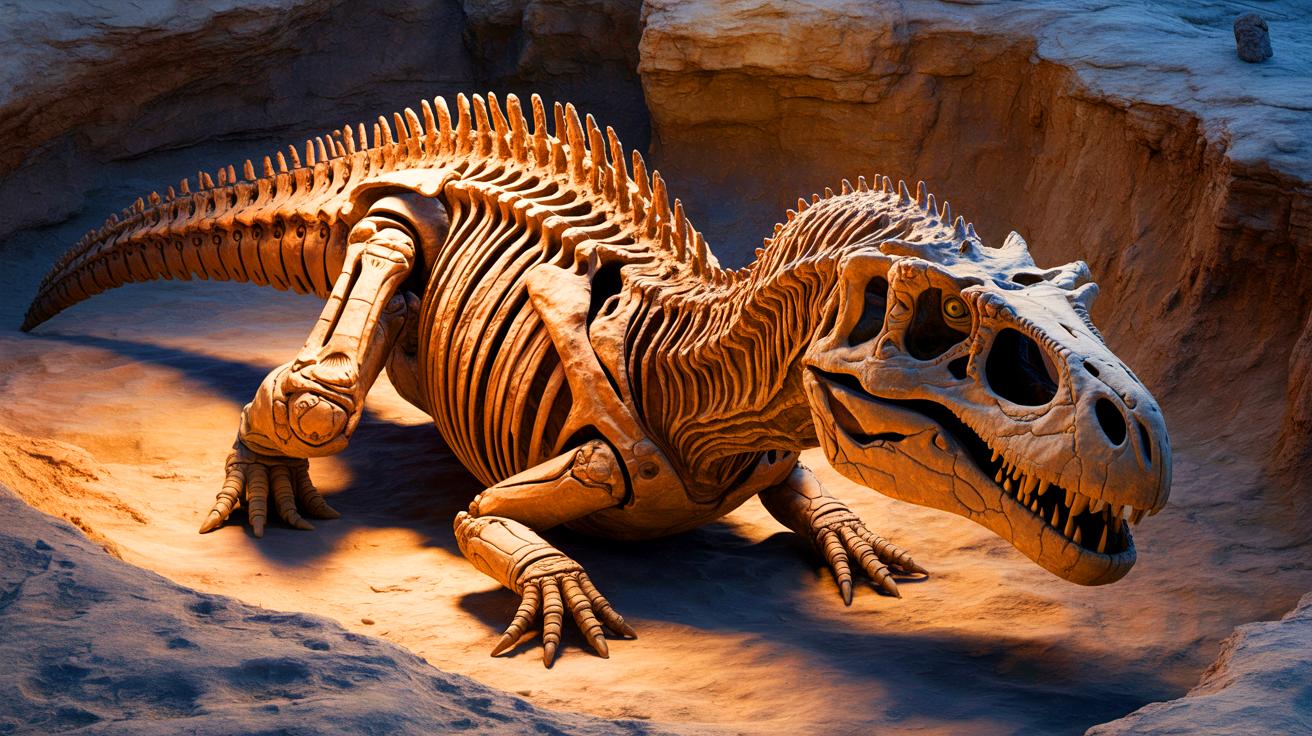
The detailed examination of two newly discovered Edmontosaurus mummies has allowed scientists to paint a comprehensive picture of this dinosaur’s external anatomy. The specimens revealed a fleshy crest running along the neck and back, a row of spikes over the tail, and intricate scaly skin patterns. These discoveries offer a first-of-its-kind view into the life of the Edmontosaurus, revolutionizing our understanding of its physical appearance.
Dr. Sereno noted that the two mummies complemented each other beautifully, providing a whole profile rather than scattered fragments. For years, paleontologists relied on incomplete fossil records, leaving much to speculation. Now, with these mummies, a clearer and more accurate depiction of the Edmontosaurus is possible, shedding light on its behavior and environment.
Hooves on a Dinosaur: A Stunning Discovery
Perhaps the most surprising revelation from this study is the discovery of hooves on the Edmontosaurus. Traditionally associated with mammals like horses, the presence of hooves on a dinosaur challenges our understanding of vertebrate evolution. This marks the earliest known instance of hooves in a land vertebrate, suggesting a complex evolutionary path leading to modern mammals.
Sereno highlighted the significance of this find:
“There are so many amazing ‘firsts’ preserved in these duck-billed mummies – the earliest hooves documented in a land vertebrate, the first confirmed hooved reptile, and the first hooved four-legged animal with different forelimb and hindlimb posture.”
These hooves provide new insights into how the Edmontosaurus moved and interacted with its environment, offering clues about its survival strategies and ecological role.
The study of these Edmontosaurus mummies not only enriches our knowledge of dinosaur biology but also inspires new questions about evolutionary history. As paleontologists continue to explore these ancient remains, they open the door to a deeper understanding of the diverse life forms that once inhabited our planet. What other secrets might be hidden within the fossilized remains waiting to be discovered?
Continue reading