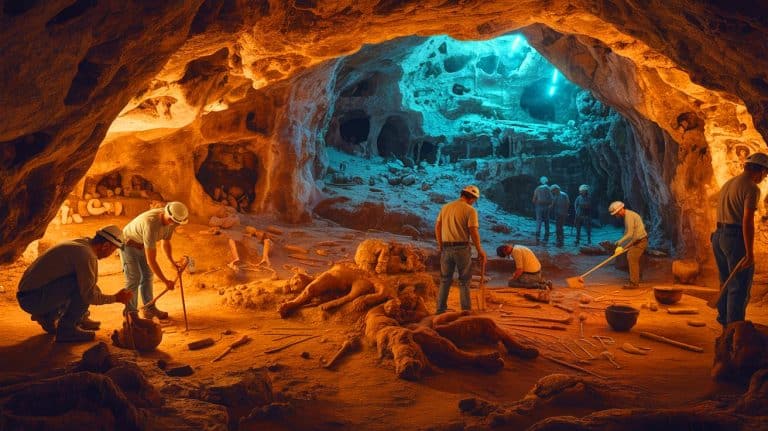



“They Found the Tree That Witnessed Earth’s Last Magnetic Flip”: Ancient Fossil Reveals How a 42,000-Year-Old Geomagnetic Reversal Transformed the Planet
 By
Joseph Mwangi
By
Joseph Mwangi

| IN A NUTSHELL |
|
In an extraordinary discovery, a fossilized tree trunk, perfectly preserved for 42,000 years, has provided scientists with an unprecedented window into a time when Earth’s magnetic field experienced a dramatic reversal. This pivotal moment, known as the Laschamps Excursion, offers insights into a period of environmental upheaval with potential implications for the evolution of life on Earth. By analyzing this ancient tree, researchers have been able to reconstruct a timeline of atmospheric changes, revealing a world marked by increased cosmic radiation and altered climatic conditions. This research not only reshapes our understanding of past geomagnetic events but also raises questions about the potential effects of future magnetic field disruptions.
The Role of Earth’s Magnetic Field
The Earth’s magnetic field is a crucial component of our planet, responsible for shielding us from harmful solar winds and maintaining our atmosphere. It is not just a navigational aid; its presence is fundamental to life on Earth. Without it, the planet would be a harsh environment, constantly bombarded by charged particles from the sun. The magnetic field acts as a protective barrier, deflecting these particles and ensuring the stability of our atmosphere.
However, the magnetic field is not a constant, unchanging force. It is dynamic and fluctuates over time. Scientists have observed that every few hundred thousand years, the magnetic poles switch places, a phenomenon known as a geomagnetic reversal. These reversals can last for thousands of years and have occurred throughout Earth’s history. In between these major events, shorter disruptions known as geomagnetic excursions take place, temporarily altering the magnetic field’s structure.
The last full geomagnetic reversal occurred 780,000 years ago, but the Earth has experienced several geomagnetic excursions since then. These events, although temporary, can have significant impacts on the planet’s environment and climate. Understanding these changes is vital, as it helps scientists predict the potential consequences of future magnetic field shifts.
The Laschamps Excursion and Its Impact
The Laschamps Excursion, the most recent geomagnetic excursion, occurred around 42,000 years ago. During this event, the magnetic poles flipped for approximately 800 years before returning to their original positions. While the existence of such events has been known, the precise effects on life and the environment remained a mystery until the discovery of the ancient tree in New Zealand.
The kauri tree, unearthed by workers preparing a site for a power plant, provided an invaluable record of environmental conditions during the Laschamps Excursion. Its rings, spanning 1,700 years, contained data that allowed scientists to measure changes in atmospheric radiocarbon levels, offering a detailed timeline of the Earth’s atmosphere during this period. This discovery was groundbreaking, as it enabled researchers to correlate atmospheric changes with geomagnetic shifts for the first time.
Using this data, scientists ran global climate models to explore the environmental effects of the magnetic field’s disruption. The findings revealed a period of dramatic change, characterized by a depleted ozone layer, increased ultraviolet radiation, and heightened atmospheric ionization. These conditions would have significantly impacted life on Earth, potentially influencing human behavior and the survival of various species.
Speculations and Controversies
The study’s findings extend beyond environmental changes, suggesting potential links between the Laschamps Excursion and significant developments in human history. One hypothesis posits that the increase in ultraviolet radiation drove early humans to seek shelter in caves, leading to a surge in cave art. The red ochre handprints commonly found in these artworks may have served as a form of sunscreen, protecting against harmful UV rays.
Moreover, the study speculates that the environmental upheaval contributed to the extinction of several megafauna species and may have accelerated the demise of the Neanderthals. While these ideas are intriguing, they have sparked debate within the scientific community. Some experts, like Chris Stringer from the Natural History Museum of London, acknowledge the study’s importance but caution against drawing definitive conclusions from its hypotheses.
Despite these controversies, the research highlights the potential impact of geomagnetic events on the evolution of life. It underscores the importance of understanding these phenomena, as they could hold key insights into the challenges faced by ancient populations and the adaptations that ensured their survival.
Implications for the Present and Future
The insights gained from the Laschamps Excursion study extend beyond historical curiosity; they offer valuable lessons for today’s world. The current movement of the north magnetic pole and the weakening of the Earth’s magnetic field suggest that another geomagnetic event could be on the horizon. If such an event were to occur, it could have profound implications for modern society.
Alan Cooper, a co-lead author of the study, warns that a geomagnetic reversal today could disrupt power grids and satellite networks due to increased cosmic radiation. The consequences would be far-reaching, affecting technology, communication, and daily life. The study serves as a reminder of the interconnectedness of Earth’s systems and the potential vulnerabilities of our technological infrastructure.
As we continue to monitor changes in the Earth’s magnetic field, the findings from this ancient tree provide a valuable framework for understanding the potential impacts of future geomagnetic events. They challenge us to consider how we might prepare for and mitigate the effects of such disruptions in an increasingly interconnected world.
The discovery of the ancient kauri tree in New Zealand has reshaped our understanding of geomagnetic excursions and their potential impacts on the environment and life on Earth. By providing a detailed record of the Laschamps Excursion, this study offers insights into a period of profound change, raising questions about the future of our planet’s magnetic field. As we consider the implications of potential geomagnetic shifts, we must ask: How can we better prepare for the challenges posed by these dynamic forces of nature?
Continue reading