



“They Were Here Long Before”: This Moroccan Discovery Destroys the Myth That Civilization in North Africa Began With the Phoenicians
 By
Nomvula Dlamini
By
Nomvula Dlamini
| IN A NUTSHELL |
|
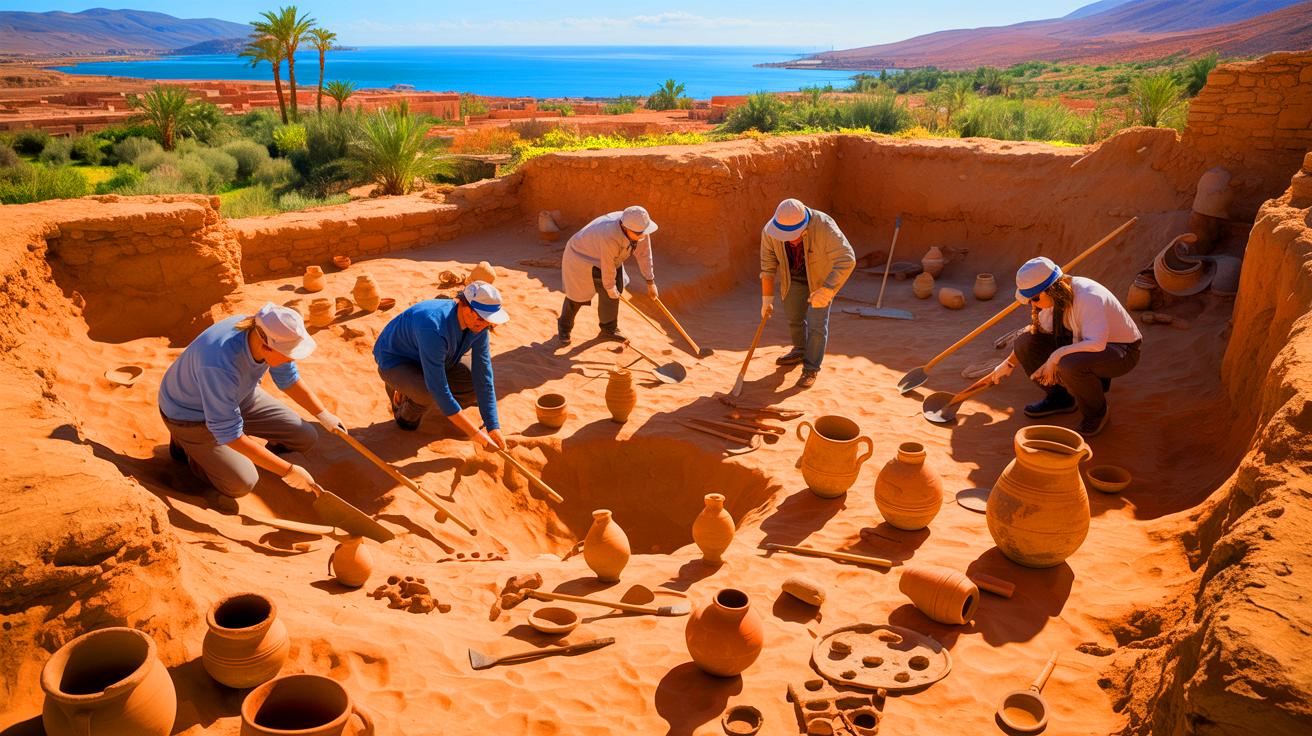
Recent archaeological findings at Kach Kouch in Morocco have unearthed compelling evidence that challenges long-held beliefs about the history of the Maghreb region in north-west Africa. Contrary to the notion that this area was uninhabited until the arrival of the Phoenicians around 800 BCE, the discovery indicates the presence of stable agricultural settlements more than 3,000 years ago. These findings suggest a rich and complex history of interaction with other Mediterranean societies during the Bronze Age. This revelation could redefine our understanding of the cultural and historical dynamics of the region, offering a new perspective on the connections between the Maghreb and the broader Mediterranean world.
Uncovering the Past: How the Discovery Was Made
The journey to uncover the secrets of Kach Kouch began with its initial identification in 1988 and subsequent excavation in 1992. Originally, researchers believed the site was inhabited between the 8th and 6th centuries BCE, largely based on the Phoenician pottery found at the site. However, recent efforts have dramatically altered this timeline. In 2021 and 2022, a team of researchers employed modern technology, including drones and differential GPS, to conduct a more thorough investigation.
These advanced methods allowed for the precise collection of samples, leading to the discovery of fossilized seeds and charcoal. Through detailed analysis, researchers were able to reconstruct the settlement’s economy and natural environment during prehistoric times. This rigorous approach has provided a clearer picture of how the inhabitants of Kach Kouch lived and interacted with their environment, revealing a sophisticated society that thrived long before the arrival of the Phoenicians.
Revealing the Remains: Insights into Ancient Life
The excavation at Kach Kouch unearthed three distinct phases of occupation, spanning from 2200 to 600 BCE. The earliest phase, dating back to 2200 - 2000 BCE, revealed scant remains, including undecorated pottery, a flint flake, and a cow bone. While the scarcity of materials suggests possible erosion or temporary occupation during this time, the subsequent period showed more extensive habitation. From 1300 BCE, the site was permanently occupied by a community that engaged in agriculture and animal husbandry.
These inhabitants lived in circular dwellings made of wattle and daub, a construction technique using wooden poles and mud. They also dug silos into the rock to store their agricultural products. Evidence shows they cultivated wheat, barley, and legumes, while raising cattle, sheep, goats, and pigs. The presence of grinding stones and flint tools, along with decorated pottery, highlights their craftsmanship. Notably, the discovery of the oldest known bronze object in north Africa, excluding Egypt, underscores the technological advancement of this society.
Interactions with the Phoenicians: A Cultural Exchange
By the 8th to 7th centuries BCE, Kach Kouch had entered what is known as the Mauretanian period. During this time, the settlement maintained its material culture and economy while beginning to interact with the incoming Phoenician communities. This interaction led to the adoption of new cultural practices, including changes in architecture and agriculture.
The coexistence of circular and square dwellings, combining local and Phoenician construction techniques, exemplifies this cultural exchange. Additionally, the introduction of new crops such as grapes and olives, and the use of wheel-made Phoenician ceramics and iron objects, further illustrate the blending of traditions. Although the settlement was peacefully abandoned around 600 BCE, likely due to social and economic changes, the legacy of Kach Kouch's inhabitants continued to influence the region.
Who Were the Bronze Age Inhabitants?
The identity and social structure of the Bronze Age inhabitants of Kach Kouch remain subjects of intrigue. While it is unclear whether they lived in tribes or were organized as families, burial practices suggest the absence of clear hierarchical structures. The inhabitants may have spoken a language similar to Amazigh, the indigenous language of north Africa, which did not have a written form until the introduction of the Phoenician alphabet.
The cultural continuity observed at Kach Kouch implies that these populations are direct ancestors of the Mauretanian peoples of north-west Africa. This continuity provides a valuable link to understanding the broader history of the region and its people. The findings at Kach Kouch not only shed light on the past but also challenge the narratives that have historically marginalized the significance of the Maghreb in Mediterranean history.
The groundbreaking discoveries at Kach Kouch are reshaping our understanding of north Africa's past, revealing a complex and interconnected history that predates Phoenician influence. This site, the oldest known Bronze Age settlement in the Maghreb, highlights the region's long-standing connections with the Mediterranean, the Atlantic, and the Sahara. By challenging colonial narratives that portrayed the Maghreb as an isolated land, these findings call for a reevaluation of historical perspectives. As researchers continue to explore this ancient settlement, what other secrets might Kach Kouch hold about the history of north Africa and its role in the Mediterranean world?
Continue reading