



Earth Reveals Unbelievable Laser Message From Space That Shatters Everything You Thought You Knew About The Universe
 By
Kwame Asante
By
Kwame Asante
| IN A NUTSHELL |
|
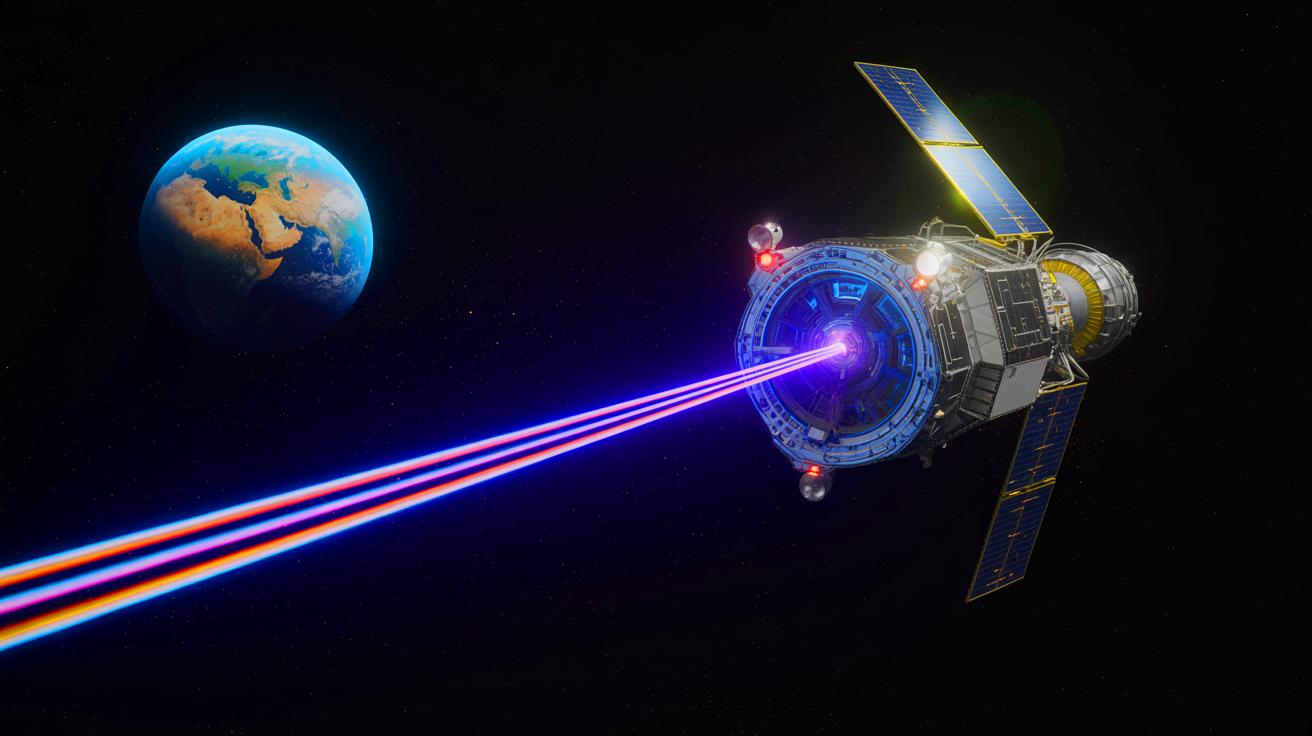
NASA has successfully concluded a pivotal phase of its Deep Space Optical Communications (DSOC) project, marking a significant milestone in space communication technology. The Psyche spacecraft, currently en route to a metal-rich asteroid, has sent its final laser message from a staggering distance of 218 million miles. This achievement not only validates the effectiveness of high-bandwidth laser transmissions over vast interplanetary distances but also sets the stage for future advancements in space communication. The DSOC experiment highlights the potential of laser communications to revolutionize how data is transmitted across the solar system, offering a promising alternative to traditional radio waves.
Pushing the Boundaries of Optical Space Communication
In December 2024, the Psyche spacecraft achieved a remarkable feat by transmitting a laser message from 307 million miles away, more than twice the average distance between Earth and Mars. This transmission was the farthest-ever laser signal received by NASA, illustrating the capabilities of the DSOC system. The project not only managed to deliver an ultra-high-definition video at 267 megabits per second from over 30.5 million miles away but also marked the end of 65 successful laser transmissions. Each transmission set new benchmarks for data transmission across the solar system.
The DSOC experiment successfully transmitted 13.6 terabytes of data back to Earth, showcasing performance levels that far exceed those of current radio-based systems. As Clayton Turner, associate administrator of NASA’s Space Technology Mission Directorate, noted, the project “surpassed our expectations,” with data rates comparable to household broadband internet. However, the performance varied with distance. As the spacecraft moved further into space, the downlink rate decreased, highlighting the precision required to maintain laser beam alignment over such vast distances.
This Shocking Discovery Reveals Earth’s Secret Plan To Split Africa And Change Our World Forever
A Shift From Radio to Laser-Based Systems
NASA’s current reliance on the Deep Space Network (DSN) for communication with spacecraft is becoming increasingly strained due to limited bandwidth. Optical communication offers a promising alternative, capable of transmitting significantly more data using focused beams of light. Sean Duffy, NASA’s acting administrator, emphasized that advancing laser technologies is a critical step toward enabling human missions to Mars. The ability to stream high-definition video and deliver data rapidly from the Martian surface could transform how we explore the Red Planet.
However, the shift to laser systems is not without challenges. Unlike radio signals, which can scatter and still reach their destination, lasers require pinpoint accuracy. Factors such as Earth’s atmosphere, weather, and light pollution can affect reception, making the technology both promising and technically demanding. This necessitates careful planning and innovation to overcome these challenges and fully realize the potential of laser-based space communication systems.
Lessons for Future Deep Space Missions
The DSOC test illuminated some of the limitations of current Earth-based reception systems. As laser beams travel through space, they degrade, and only a small number of photons reach the Earth’s surface. This necessitates the use of highly sensitive ground receivers, like those at NASA’s Optical Communications Telescope Laboratory. There’s also the possibility that future missions might require space-based relays to bypass the effects of Earth’s atmosphere entirely.
Now that the demonstration phase has ended, the Psyche spacecraft will rely on traditional radio communications for the remainder of its mission. This underscores the need for continued innovation and development in laser communication technologies to ensure their viability for long-distance and complex mission scenarios. The DSOC project has laid a strong foundation, but further advancements are needed to fully harness the potential of optical communication in deep space exploration.
Implications for Future Exploration
The success of the DSOC project represents a major leap forward in space communication technology. As the demand for higher data rates and more efficient communication methods continues to grow, laser-based systems are poised to play a crucial role in future space missions. The ability to transmit large amounts of data quickly and reliably across vast distances could significantly enhance our understanding of the solar system and beyond.
As NASA continues to push the boundaries of what is possible, the lessons learned from the DSOC project will be invaluable. The transition to laser-based systems will require overcoming significant technical challenges, but the potential benefits are immense. As we look to the future, the question remains: how will these advancements shape the next era of space exploration and our understanding of the universe?
Continue reading