

This Shocking Discovery Reveals Earth’s Secret Plan To Split Africa And Change Our World Forever
 By
Nomvula Dlamini
By
Nomvula Dlamini
| IN A NUTSHELL |
|
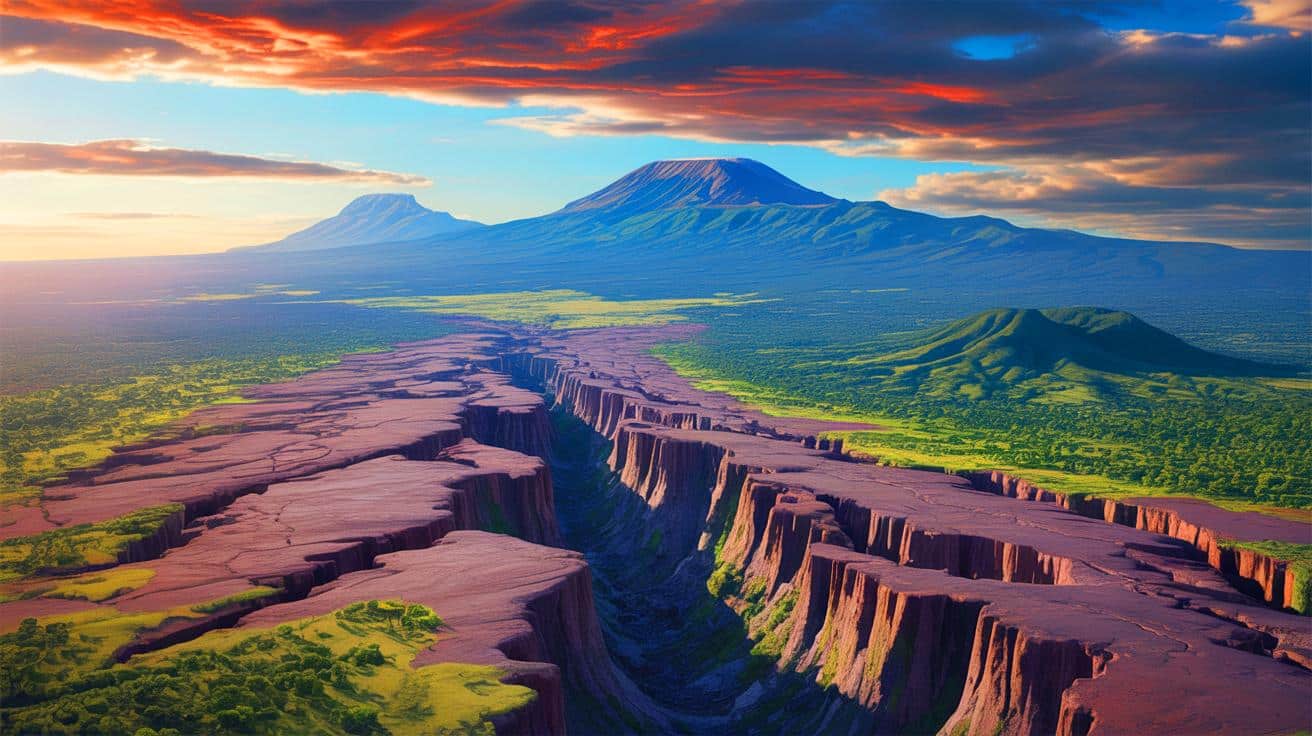
In recent years, geologists have been closely observing a remarkable geological phenomenon unfolding in East Africa. An extensive rift, stretching thousands of miles from northern Ethiopia to southern Malawi, signals the potential splitting of the African continent. Though this process appears slow and silent on the surface, a colossal force beneath the Earth’s crust might eventually tear the continent into two distinct land masses. This phenomenon, known as the East African Rift System, is not only one of the largest and most active geological formations in the world, but it also presents significant implications for the region’s energy resources and scientific research.
The Enormous Rift and Its Energy Implications
The East African Rift System spans an impressive 4,000 miles and crosses over a dozen countries. Marked by valleys, geological fractures, and significant seismic activity, this rift is also home to some of the world’s most famous volcanoes, including Mount Kilimanjaro, Mount Kenya, and Mount Nyiragongo. These volcanic landscapes are not just of interest to scientists studying geological activity; they also represent a vital energy resource for the region.
For instance, Kenya has leveraged the geothermal energy generated by the rift to become a global leader in renewable energy production. Nearly 90% of Kenya’s electricity comes from renewable sources, with geothermal energy playing a substantial role. The ability to harness the Earth’s heat provides not only a sustainable energy source but also offers unique opportunities for scientific exploration. Geothermal drilling allows researchers to access unprecedented data about deep Earth processes, leading to accelerated discoveries in recent years.
Unveiling Deep Earth Secrets Through Chemistry
A recent study published in Geophysical Research Letters has highlighted the significance of noble gases, particularly neon, in understanding the geological activity beneath the East African Rift. Researchers from the University of Glasgow investigated the noble gases present in the Menengai geothermal field in Kenya. Neon isotopes, in particular, serve as critical indicators of the origin of Earth’s materials, retaining the trace of their source intact.
The findings revealed that the neon found in Kenya carries a chemical signature originating from the deep mantle, likely at the boundary between the Earth’s outer core and its mantle. This signature was not only present in Kenya but also detected in other parts of the rift, such as the Afar plume basalts in Ethiopia and the Western Rift Valley between Uganda and the Democratic Republic of Congo. These results suggest a shared geological source, indicating a giant geothermal reservoir deep within the Earth.
A Geological Force Reshaping the Continent
The study’s authors propose a compelling hypothesis: the presence of a singular superplume, a massive upwelling of hot rock that is physically lifting East Africa’s crust. This geological force contributes to the region’s unusually high elevation – hundreds of feet above the surrounding areas – and plays a crucial role in the dynamic opening of the rift.
Further research conducted by Virginia Tech in 2023 offers additional insight into this phenomenon. In certain rift zones, crustal deformations occur parallel to the faults, rather than perpendicular as typically expected. This unusual behavior can only be explained by the movement of magma, fueled by the deep superplume. The implications of these findings extend beyond immediate geological processes, impacting our understanding of continental drift and tectonic activity on a global scale.
Will Africa Eventually Split Apart?
Currently, the East African Rift appears stable from a human perspective, but on a geological time scale, it is undergoing significant transformation. The forces at work might eventually lead to a complete separation of East Africa from the rest of the continent, potentially forming a new ocean between the two land masses.
While this scenario remains hypothetical, the convergence of geophysical, geochemical, and geological evidence increasingly supports this possibility. Not all rifts result in oceanic division, but the ongoing research and observations suggest that the East African Rift could be an exception, offering a rare glimpse into the Earth’s evolving nature.
A Scientific and Energy Opportunity
The developments beneath East Africa are more than just geological phenomena; they provide a window into the planet’s internal dynamics, a rare scientific testing ground, and a critical energy resource for the region’s development. The answers to fundamental questions about continental evolution and ocean formation may already lie within the Earth’s depths, waiting to be uncovered.
As we continue to study these dynamic processes, we must consider the broader implications for both science and society. How will these discoveries shape our understanding of Earth’s geological future, and what potential benefits could they offer to humanity? The unfolding story of the East African Rift challenges us to explore these questions with curiosity and scientific rigor.
Continue reading