


“They Used Water to Lift the Stones”: New Discovery at Saqqara Reveals Ancient Egyptians May Have Built Pyramids With Hydraulic Power
 By
Kwame Asante
By
Kwame Asante
| IN A NUTSHELL |
|
In a remarkable turn of events, archaeologists have uncovered evidence that may forever change our understanding of ancient Egyptian engineering. Located at the heart of the Egyptian desert, the discovery of a sophisticated water management system around the Pyramid of Djoser suggests that the builders of this ancient monument employed advanced construction techniques. This revelation challenges long-standing assumptions about Old Kingdom methodologies and highlights the technical prowess of ancient Egyptians, who may have harnessed hydraulic power to achieve monumental architectural feats.
Ingenious Stone Dam Capturing Desert Floodwaters
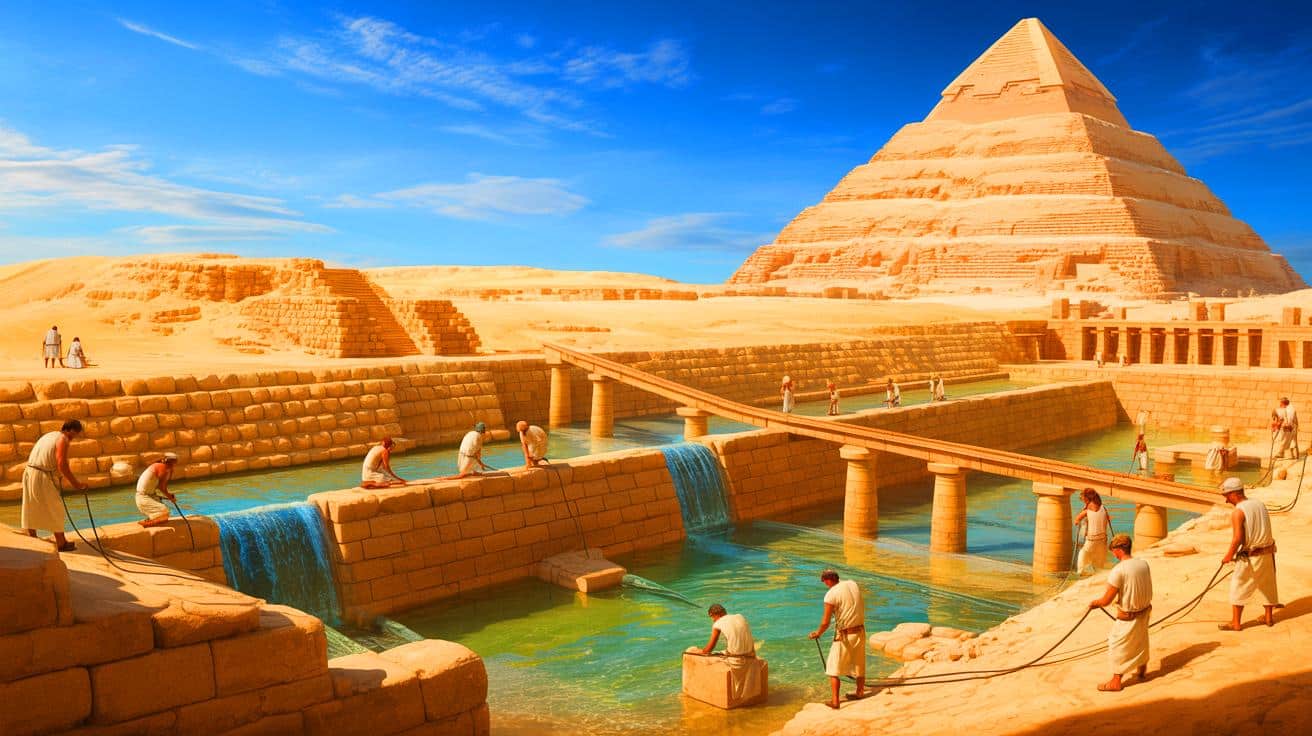
For years, the mysterious structure at Saqqara, known as Gisr el-Mudir, has baffled researchers. Spanning nearly 1,180 feet, it is one of Egypt’s oldest constructions. Recent studies by Xavier Landreau and his team from the CEA Paleotechnic Institute, published in PLOS ONE, suggest that this ancient stone enclosure functioned as a dam. Its purpose was to capture seasonal floodwaters from nearby wadis, a hypothesis that reshapes our understanding of the site’s role in history.
After analyzing terrain slopes, ancient watercourses, and erosion marks, researchers reconstructed a watershed capable of channeling water to the enclosure. This would have served as a temporary reservoir, storing up to 14 million cubic feet of water. Such a supply could support large-scale construction projects, with seasonal floods depositing sediments in naturally arranged basins downstream. The discovery suggests that Saqqara’s location was chosen not just for religious or political reasons but also for its geological and hydrological advantages.
How Hydraulic Construction of Pyramids Worked
While having an ample water supply was essential, moving the massive limestone blocks required more innovation. The secret lies beneath the Djoser complex. A vast trench carved into the rock, known as the “Deep Trench,” reveals a series of interconnected basins and compartments. Initially thought to be symbolic, this network functioned as a water treatment system, clarifying water through sedimentation.
This purified water likely powered a vertical lifting system. Two vertical shafts, linked by a 656-foot-long underground gallery, would have used a flotation device. Blocks placed on a floating platform could be elevated by the pressure of water injected into the shafts. Once the blocks reached the desired height, they could be moved onto the pyramid’s upper tiers. The observed structures in the galleries and compartments support the hypothesis of a hydraulic elevator system, showcasing how water’s force was harnessed to reduce mechanical effort.
Sophisticated Technology Matching Pharaohs’ Ambitions
The hypothesis of hydraulic construction is backed by concrete evidence on-site. The dam, basins, galleries, and shafts present a logical organization for a hydraulic chain. Contrary to popular belief, the Egyptians possessed sophisticated water-related techniques, including irrigation canals, wooden gates, and agricultural dams. This study reveals that such a system could reduce the need for massive external ramps, lowering labor demands and logistical constraints. The project would gain efficiency, safety, and precision.
This advanced engineering level prompts a reevaluation of other Old Kingdom monuments. The Pyramid of Djoser, often seen as a prototype, may have been the culmination of a highly developed technology that later dynasties struggled to replicate. This revelation challenges the traditional narrative of pyramid construction, suggesting a blend of ingenious engineering and resourceful adaptation to environmental challenges.
How Saqqara’s Hydraulic Remains Alter Our Historical Perspective
Traditionally, pyramids have been studied from a symbolic or architectural standpoint. The discovery of an extensive hydraulic system opens new exploration avenues. It shows that builders of the era were not merely executing a religious project but were crafting a sustainable technical ecosystem, adapted to environmental and resource constraints.
This multidisciplinary approach, combining archaeology, hydrology, and geotechnics, enriches our understanding of the past. It unveils sophisticated work organization, rigorous material management, and nuanced exploitation of the territory. It’s conceivable that the pyramids were not solely the result of massive labor mobilization but also the outcome of underestimated technical genius. This perspective sheds new light on ancient Egyptian innovation and invites us to reassess other monumental sites, seeking similar traces of hydraulic systems.
As more is uncovered about the ancient Egyptians’ engineering prowess, we are left to ponder: What other technological marvels lie hidden beneath the sands, waiting to rewrite history once more?
Continue reading