



Voyager 1 Reveals This Shocking Discovery That Terrifies Scientists And Changes Everything About Space Exploration Forever
 By
Kwame Asante
By
Kwame Asante
| IN A NUTSHELL |
|
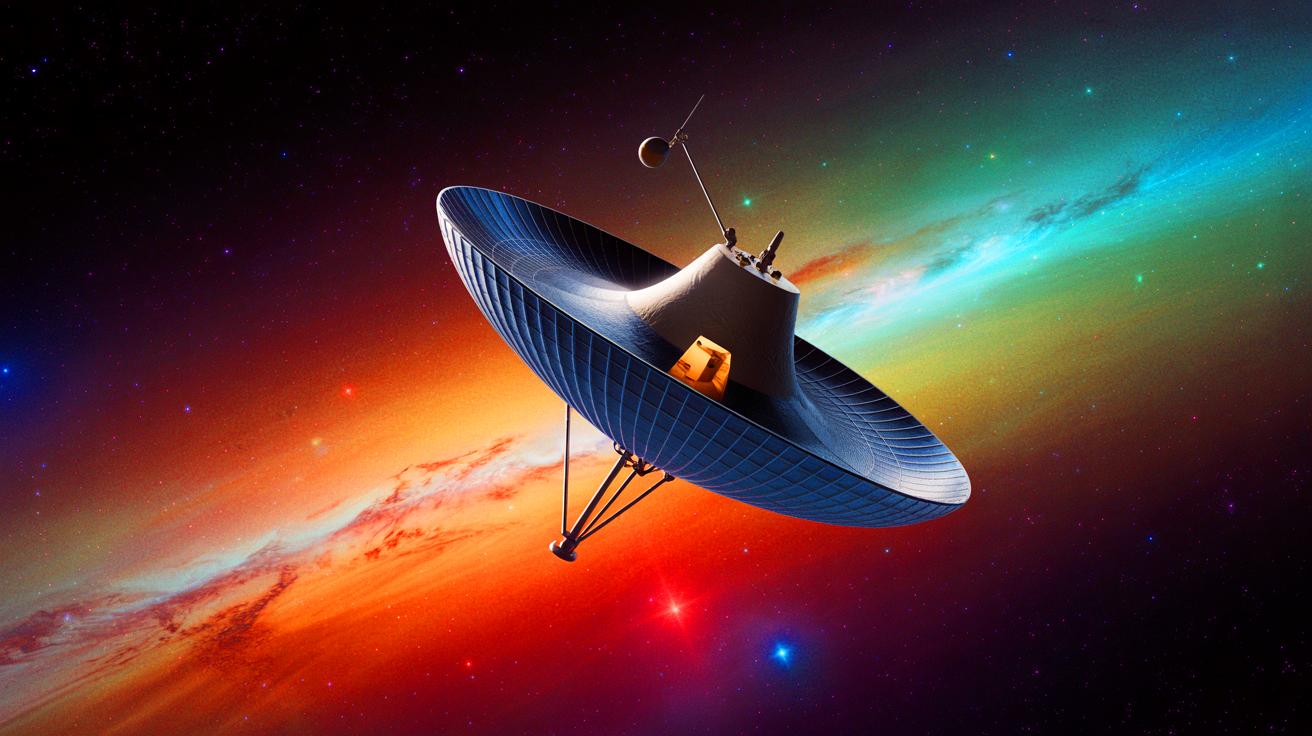
In the vast expanse of space, Voyager 1 stands as a testament to human ingenuity and curiosity. Launched nearly five decades ago, this spacecraft is poised to become the first human-made object to reach a distance of one light-day from Earth. This milestone, expected on November 15, 2026, marks a significant chapter in space exploration. Originally designed to study the outer planets, Voyager 1 has far surpassed its initial mission. It now serves as a beacon of our relentless pursuit to understand the universe, sending invaluable data back to Earth even as it traverses the interstellar medium.
The Journey Beyond the Heliopause
Voyager 1’s journey is nothing short of extraordinary. Launched in 1977, the spacecraft has traveled more than 16 billion miles from Earth. Moving at an impressive speed of approximately 38,000 miles per hour, Voyager 1 has broken numerous records. In 2012, it became the first spacecraft to cross the heliopause, the boundary where the Sun’s solar wind ceases to be effective. This marked its entry into interstellar space, a region where the influence of solar particles ends, and the space between stars begins.
Despite the vast distance, Voyager 1 continues to transmit signals back to Earth. These signals, though weak, take nearly a full day to reach us, underscoring the immense scale of its journey. On January 28, 2027, Voyager 1 is expected to be one light-day from the Sun, a symbolic milestone that parallels its journey away from Earth. This achievement not only highlights the spacecraft’s remarkable capabilities but also the dedication of the engineers and scientists who have supported it over the years.
Where Does the Solar System End?
The question of where the solar system ends is a complex one. According to NASA, the solar system doesn’t have a definitive boundary. Instead, it tapers off in stages. The heliopause is one such stage, marking the end of the Sun’s solar wind. Beyond this lies the Oort Cloud, a hypothetical cloud of icy bodies, and eventually, the Sun’s gravitational influence itself.
South Africa Reveals Game-Changing Lunar Mission With China That Terrifies Space Giants Worldwide
At Voyager 1’s current speed, it would take nearly 40,000 years to reach the outermost edge of the Sun’s gravitational domain, estimated to be about two light-years away. This staggering distance illustrates the minuscule nature of our exploratory steps on a cosmic scale. Yet, each mile that Voyager 1 travels contributes to our understanding of the solar system’s limits. Its data continues to inform scientists as they refine models of the Sun’s influence in the interstellar medium.
The Legacy of Endurance and Discovery
Voyager 1’s mission is a testament to endurance and discovery. Over 45 years since its launch, the spacecraft remains operational, sending valuable information back to Earth. This longevity exemplifies a remarkable feat of engineering and scientific dedication. While faster missions have come and gone, Voyager 1 demonstrates the rewards of patience and continuity in space exploration.
The spacecraft’s success is not measured by speed but by its sustained journey across time. Despite dreams of faster-than-light travel, reality remains subluminal. The record set by Apollo 10 – nearly 25,000 miles per hour – still stands. Yet, Voyager 1’s accomplishment lies in its continuous movement, serving as a reminder of humanity’s desire to reach the unknown. The faint signals it sends back are poetic reminders of how far we have come and the vast distances that still lie ahead.
Table: Voyager 1’s Milestones
| Milestone | Date | Distance from Earth |
|---|---|---|
| Launch | September 5, 1977 | 0 miles |
| First to Cross the Heliosphere | August 25, 2012 | 11 billion miles |
| One Light-Day from Earth | Expected November 15, 2026 | 16 billion miles |
As Voyager 1 continues its journey into the unknown, it expands the boundaries of human knowledge and achievement. Its mission challenges us to consider the vastness of space and our place within it. As we look to the future, we must ask ourselves: What new frontiers will we explore, and how will our understanding of the universe evolve in the coming decades?
Continue reading