

Archaeologists Reveal Hidden Human Figure That Shatters Everything We Knew About World’s Oldest Temple’s Mysteries
 By
Kwame Asante
By
Kwame Asante
| IN A NUTSHELL |
|
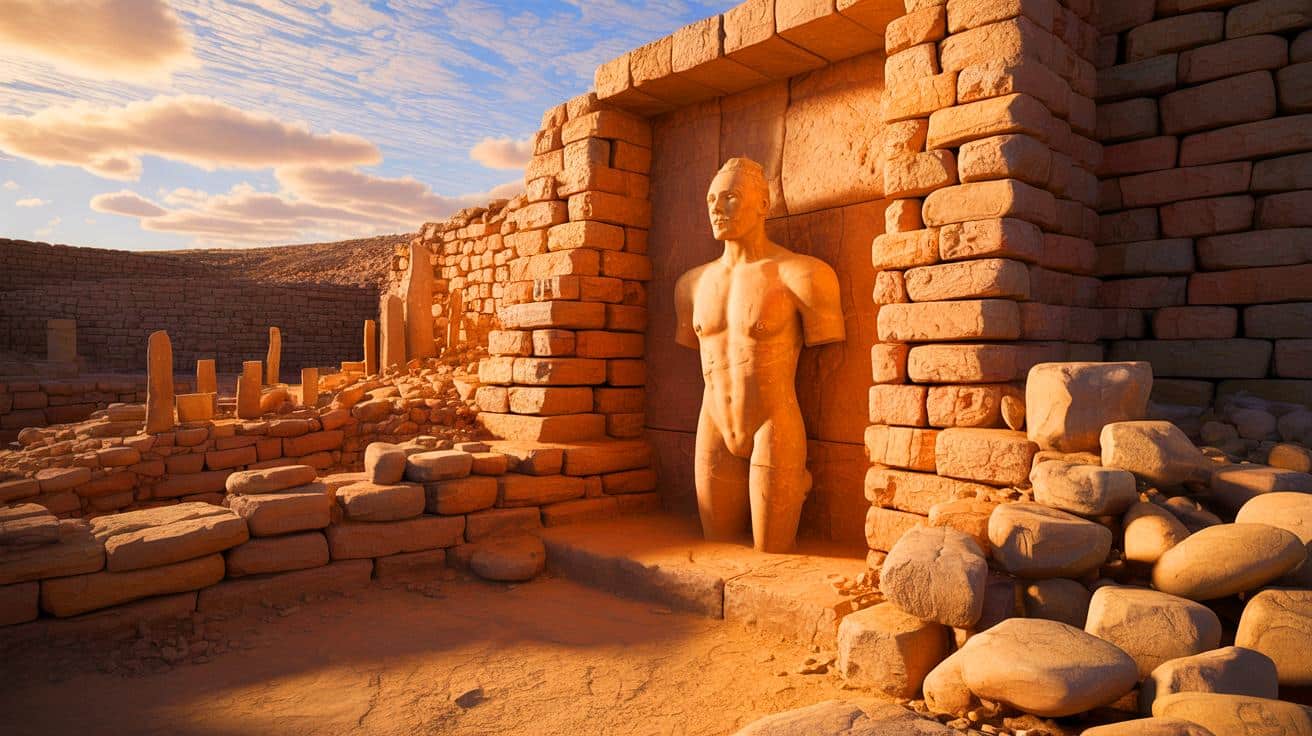
The recent discovery of a 12,000-year-old human-shaped statue at Göbekli Tepe, the world’s oldest known temple complex in southeastern Turkey, has captured the attention of archaeologists and historians worldwide. Unearthed during restoration efforts, this intricately carved stone figure was found embedded within a wall between Structures B and D, key enclosures of the site. Positioned horizontally, the figure hints at symbolic or ritual significance during the Neolithic era. This revelation offers a new lens through which to explore the spiritual and ceremonial practices of early human communities, and adds to Göbekli Tepe’s already monumental historical importance.
Symbolic Placement in Monumental Architecture
The deliberate positioning of the human figure within the wall of Göbekli Tepe suggests a symbolic rather than practical purpose. Experts believe the statue could have served as a guardian or votive offering, integral to the site’s ceremonial architecture. Archaeologists involved in the excavation noted the careful orientation of the statue, which mirrors other sacred elements found at the site. Professor Necmi Karul, leading the excavation, highlighted the importance of this discovery during a visit by Princess Akiko of Mikasa from Japan, emphasizing its role in deepening our understanding of Neolithic rituals.
Unlike other anthropomorphic figures found at neighboring sites, this particular statue’s placement within Göbekli Tepe, the oldest known ritual site, underscores its unique significance. Its embedding within a structural wall rather than an open display suggests a belief in its ongoing spiritual presence. This aligns with Göbekli Tepe’s broader role as a ceremonial space, constructed not for daily living but for spiritual gatherings and religious symbolism.
Here’s The Discovery That Shatters Everything You Know About Humanity’s First Home Outside Africa
Insights into Early Neolithic Belief Systems
The intricate carvings on Göbekli Tepe’s T-shaped pillars, depicting animals like foxes, snakes, and vultures, have long been interpreted as symbols of spiritual or cosmological importance. The recent discovery of the human figure extends this symbolic system into the realm of three-dimensional representation. This raises new questions about how early societies integrated symbolic figures into their sacred spaces.
The statue’s partial state – with the head and torso intact but feet missing – might indicate specific ritual practices or deliberate alteration before its placement. This suggests a defined role within the site’s ceremonial framework. The integration of such figures into the architecture rather than as standalone displays suggests a belief in their enduring spiritual influence. This theory resonates with patterns observed in the Taş Tepeler Project, which studies early human sites across the Anatolian region, hinting at a shared symbolic language among Neolithic communities.
Conservation Efforts and International Engagement
Since its recognition as a UNESCO World Heritage site, Göbekli Tepe has been at the center of extensive conservation efforts. The “Legacy for the Future Project” involves over 36 institutions and 200 researchers focused on excavation and preservation. Restoration work at the site employs traditional techniques to stabilize ancient structures while accommodating modern tourism demands.
Turkey plans to enhance visitor facilities by late 2025, including a dedicated center and revamped access paths, aiming to balance public interest with site preservation. Global exhibitions have further promoted Göbekli Tepe, with significant displays in Rome and an upcoming exhibition in Berlin. Minister of Culture and Tourism Mehmet Ersoy has described Göbekli Tepe as a shared heritage of humanity, emphasizing its cultural significance beyond Turkey’s borders.
The Role of Göbekli Tepe in Understanding Human History
Göbekli Tepe continues to offer invaluable insights into the complexities of early human societies. Its monumental architecture and symbolic artistry challenge previous notions about the capabilities of pre-agricultural communities. The recent statue discovery amplifies its role in reshaping our understanding of Neolithic belief systems and social structures.
This site invites ongoing research and dialogue among archaeologists, historians, and the general public. As more artifacts and structures are uncovered, they promise to shed light on the sophisticated societal dynamics and spiritual practices of early humans. What other secrets might Göbekli Tepe hold, and how will they redefine our understanding of the dawn of civilization?
Continue reading