


“They’re Beaming the Internet Through Light”: Alphabet’s Taara Promises Speeds 100 Times Faster Than Starlink (And It’s Already Working)
 By
Joseph Mwangi
By
Joseph Mwangi
| IN A NUTSHELL |
|
In a rapidly evolving digital landscape, the quest for faster and more affordable internet access has become a global priority. While initiatives like SpaceX’s Starlink have made headlines with their satellite-based solutions, a new contender is emerging from Alphabet’s X lab – Taara. This California-based startup aims to transform internet connectivity through its innovative laser beam data transmission technology. Promising speeds up to 100 times faster than Starlink, Taara offers a compelling alternative that could reshape how we think about internet infrastructure. From reducing costs to minimizing environmental impact, Taara’s technology presents a new frontier in global connectivity.
The Lightbridge Revolution
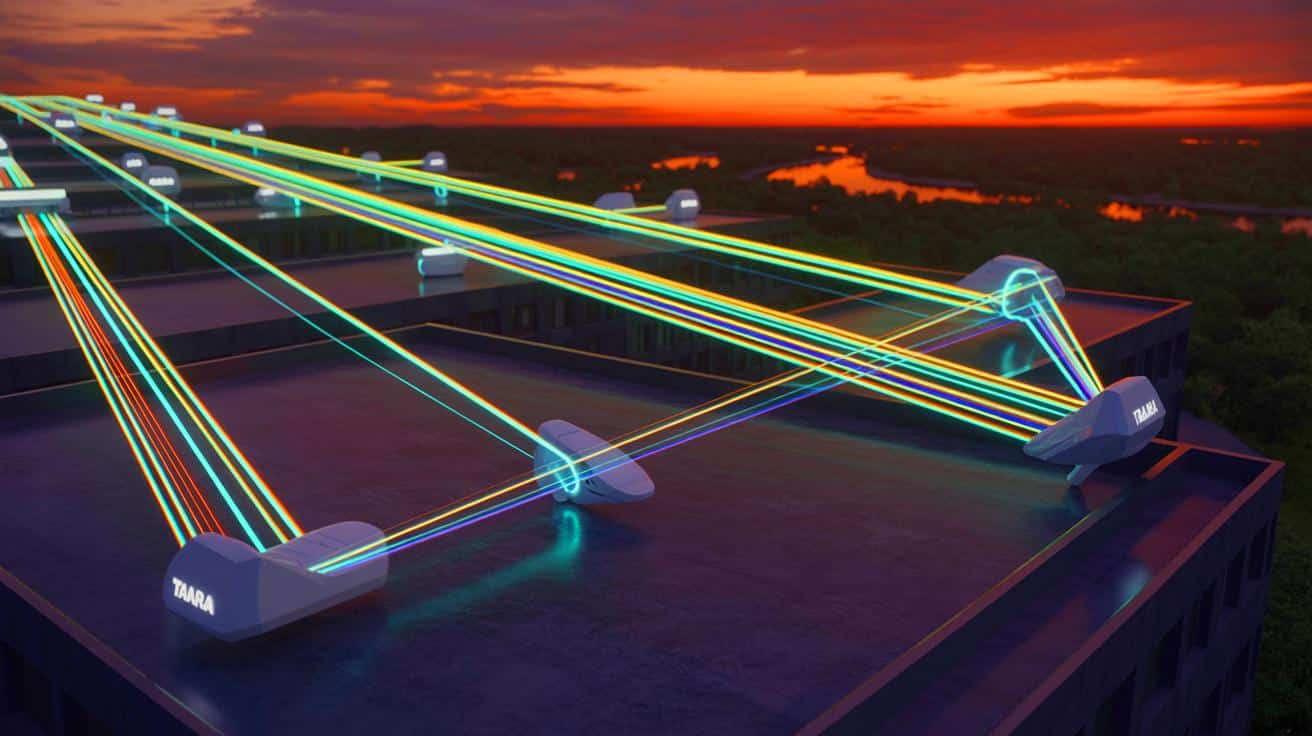
As nearly 3 billion people worldwide lack reliable or affordable internet access, Taara offers a groundbreaking alternative to traditional fiber optic and satellite-based internet solutions. Unlike Starlink, which relies on thousands of satellites in low Earth orbit, Taara uses an invisible light bridge to transmit data at the speed of light between two fixed points on Earth.
Central to Taara’s technology are the “Lightbridges,” compact units roughly the size of a traffic light. These devices can be installed on poles, rooftops, or even trees, exchanging laser beams over distances up to 12 miles. Capable of reaching speeds of 20 gigabits per second, Taara’s Lightbridges outperform the best Starlink antennas, which typically range between 100 megabits and 1 gigabit per second.
Unlike fiber optic cables, Taara’s technology eliminates the need for trenching or laying cables over miles. It also circumvents the challenges of launching equipment into space. Installation takes mere hours, resulting in a reduced environmental footprint and significantly lower infrastructure costs.
Tested and Proven Technology
Taara’s technology is not just theoretical. It has already been tested in a dozen countries, including a notable project connecting Brazzaville and Kinshasa across the Congo River. Over 700 terabytes of data were transferred across a 3-mile span with 99.99% availability, at a fraction of the cost of traditional wired or satellite links. The technology has also been employed at major events like the Coachella festival to bolster temporary mobile networks.
Despite its early successes, Taara is just getting started. The company recently announced plans to miniaturize its technology into a photonic chip by 2026. This advancement could further democratize access to ultra-fast connections, making it possible to integrate Taara’s technology into connected devices and autonomous vehicles.
Complementing, Not Competing with Starlink
While Taara boasts impressive performance metrics, the startup does not position itself as a direct competitor to Starlink. Instead, it offers a complementary solution. Starlink excels in connecting highly isolated areas, ships, and aircraft with its global coverage. In contrast, Taara targets ultra-high-speed local connections, ideal for bridging natural obstacles like rivers, mountains, and railways, serving poorly connected urban neighborhoods, or providing backup for existing networks.
However, Taara’s technology does come with a significant limitation: it requires a clear line of sight between terminals. Weather conditions like fog and heavy rain, as well as physical obstructions, can disrupt the signal. To address these challenges, Taara has developed systems for automatic alignment and dynamic beam adjustment, maintaining connectivity in 99.9% of cases, even in challenging environments like Kenya’s Rift Valley.
Scaling Up for Global Reach
Now operating independently, Taara aims to accelerate its development by securing new investors and enhancing its commercial agility. The startup is already collaborating with telecom operators, governments, and NGOs to connect rural areas, islands, industrial sites, and temporary events.
Taara’s ambition is clear: to provide fast, affordable, and abundant connectivity to everyone, everywhere. This ambitious goal highlights the company’s commitment to bridging the digital divide and making high-speed internet access a universal reality. As Taara continues to expand, its impact on global connectivity could be profound.
In an era where internet access is as crucial as any other utility, Taara’s innovative laser technology marks a significant step forward. By offering a faster, cheaper, and more environmentally friendly alternative to existing solutions, Taara is poised to make a lasting impact on how the world stays connected. As the company scales its operations and technology, the question remains: how will this new approach to internet connectivity transform our digital landscape and the lives of billions worldwide?
Continue reading