

“This Changes Human History”: This New Discovery Reveals Africa Was Rain-Soaked - Not Dry - When Our Ancestors Began to Evolve (and Scientists Are Stunned)
 By
Kwame Asante
By
Kwame Asante
| IN A NUTSHELL |
|
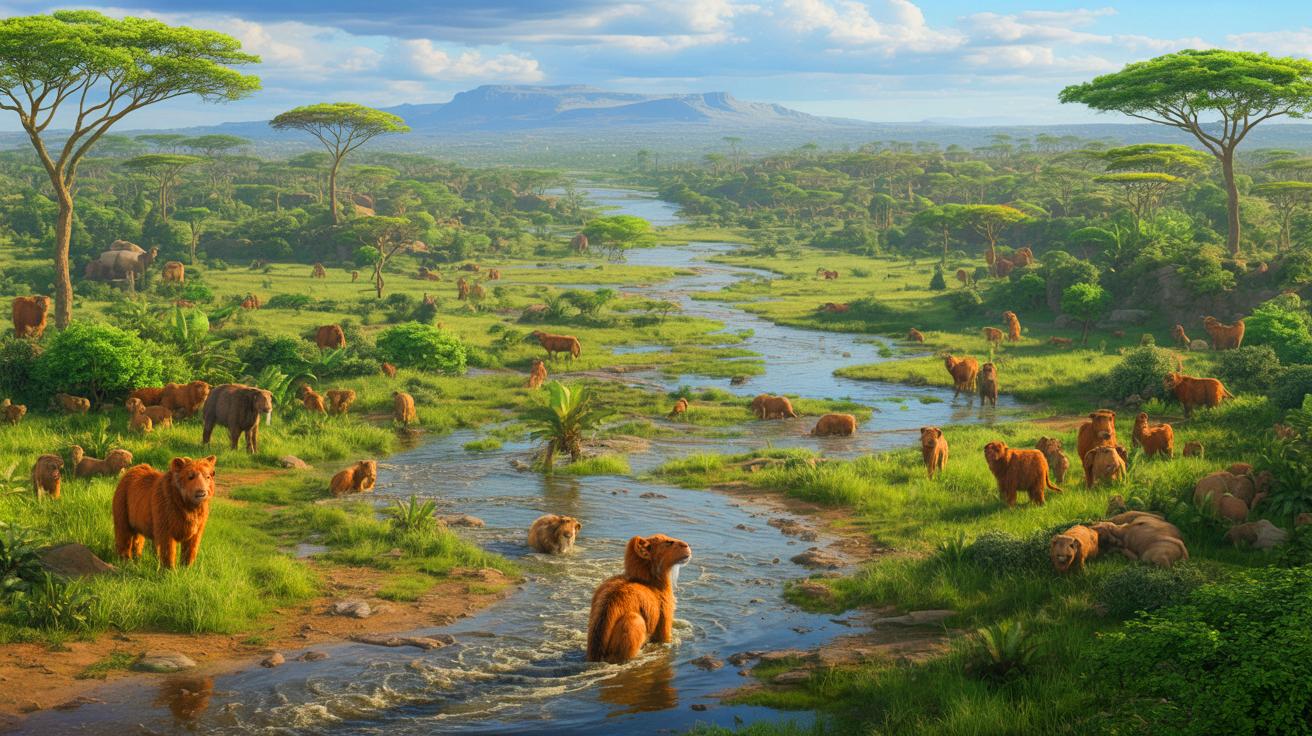
Recent scientific discoveries are challenging long-held beliefs about the climate conditions in northern Africa during a critical period of human evolution. For many years, the prevailing theory posited that increased aridity in this region played a pivotal role in shaping the evolutionary path of early humans. However, new research suggests that rather than becoming drier, northern Africa may have experienced stable, rain-soaked conditions between 3.5 and 2.5 million years ago. This revelation could significantly alter our understanding of early human development and the environmental factors that drove evolutionary changes.
The Turning Point in Human Evolution
The Plio-Pleistocene transition, spanning from 3.5 to 2.5 million years ago, has traditionally been considered a period marked by increasing aridity. This transition, which marks the shift from the wetter Pliocene epoch to the colder and drier Pleistocene epoch, was thought to have been a time when early human ancestors adapted to drier conditions. Scientists believed that this drying climate fostered the evolution of traits such as bipedalism and increased tool use. However, a recent study published in Science Advances challenges this notion. It suggests that northern Africa experienced stable rainfall during this period, contradicting the idea of a significant climatic drying trend.
This new perspective on the Plio-Pleistocene transition raises questions about the environmental pressures that influenced early human evolution. If the region was not becoming drier, as previously thought, what environmental factors were at play? These findings suggest that the evolutionary path of early humans may have been more complex than a simple adaptation to an increasingly arid landscape.
Climate Change and Human Evolution: Rethinking the Narrative
For decades, the narrative of human evolution was closely tied to the idea that climate change, specifically increasing aridity, was a driving force. It was believed that as northern Africa became drier, open grasslands spread, necessitating adaptations such as walking upright. However, the recent discovery of more humid conditions during the critical Plio-Pleistocene transition forces a reevaluation of this narrative.
According to Bryce Mitsunaga, who led the research at Brown University, the new findings indicate that precipitation cycles remained stable even as larger changes in temperature and glaciation occurred. This stability could mean that our ancestors evolved under different environmental conditions than previously thought.
“Plants produce these waxes during the summer growing season, so they provide a direct signal of summer rainfall over time,” Mitsunaga noted, highlighting the importance of understanding past climate dynamics.
What the Dust Deposits Really Tell Us
Previous interpretations of dust deposits found in ocean sediment cores off the coast of West Africa suggested a drying Sahara. These deposits, dating back to 3.5 to 2.5 million years ago, were thought to indicate desert expansion due to reduced summer monsoons. However, new research challenges this interpretation, suggesting that the dust might reflect a different climatic phase.
Mitsunaga’s research reveals that increased levels of continental dust during this period might not signify aridification but rather more stable climatic conditions.
“Increased levels of continental dust were found in samples dating from 3.5 million to 2.5 million years ago,” Mitsunaga explained, indicating that these findings could reshape our understanding of past climates.
This new perspective suggests that the Sahara’s expansion may not have been as straightforward as once believed, adding complexity to our understanding of ancient environmental changes.
The Implications of a Rain-Soaked Africa
If northern Africa was indeed wetter than previously assumed, the implications for our understanding of early human evolution are profound. A stable climate could have supported the survival and diversification of various hominin species in different ecological niches. This stability might mean that the development of bipedalism, tool use, and other human traits were influenced by a more intricate interplay of environmental factors than the simple narrative of adaptation to a drying world.
The potential for modern-day applications of this research is significant.
“If we can see how global climate influenced what the water cycle is doing at that point in history, it could inform predictions of future rainfall in this already water-stressed region,” Mitsunaga emphasized.
As new data continues to reshape our understanding of human evolution, it becomes apparent that our origins may be more nuanced than previously imagined.
The evolving story of our ancestors reflects the ever-changing nature of scientific inquiry. As research uncovers new evidence, our understanding of human evolution continues to evolve. How will these findings influence future studies on human origins and the environmental factors that shaped them?
Continue reading